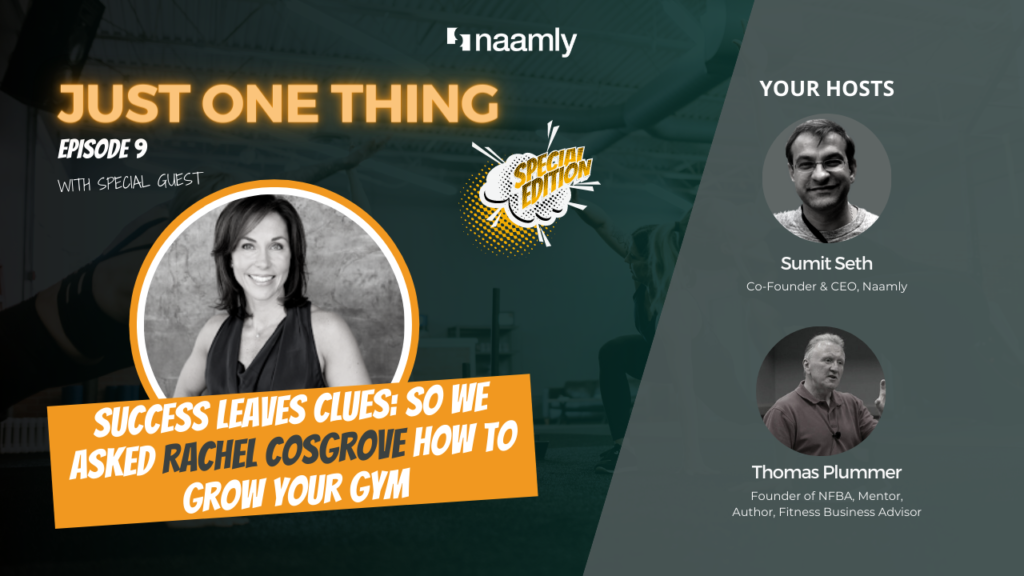
Rachel Cosgrove is responsible for building & growing two successful businesses each reaching 7-figure earnings a year. She is the best-selling author of two books, a widely recognized speaker, and a commonly regarded mentor to inspired fitness entrepreneurs.
We know that success leaves clues… So instead of asking Rachel for her “Top 5 Sales Tips” or something you can find anywhere, we decided to ask her the hard questions. The questions we thought would matter most to you!
In this special & extended edition of Just One Thing, we ask Rachel:
- What success looks like to her and how she uses that to make better decisions.
- How she navigates running multiple businesses during times of crisis (like COVID).
- How to thrive as a female fitness entrepreneur in a male-dominated industry.
- Some of her favorite book recommendations.
Plus so much more!
If you’re ready to hear the ups and downs of growing a successful fitness business, you’ll want to check out this uncut and unedited episode of Just One Thing!
Are you trying to scale your business but don’t know where to start? We help training gym owners like you (and Rachel Cosgrove) take control over their business operations and communications. Save yourself tremendous time, effort, and money by starting your FREE Naamly trial today! You’ll quickly see the impact it has on your client experience and team performance (we promise)!
Watch The Full Episode
Thomas Plummer: Perfect. Well, um,
Sumit: Hey everyone, I am super excited to have Rachel Cosby today. She is a successful business owner, author, presenter, and a mentor to a number of fitness businesses through her results, fitness university that she co owns with her husband, Alan cause growth out of California. And, uh, so Rachel, welcome to the show.
We are stoked
Rachel Cosgrove: to. Well, thank you. Thank you for having me.
Thomas Plummer: Uh, Tom it’s. Uh, why don’t I have used lead with
Sumit: the questions initially? As I try to get myself warmed up about
Thomas Plummer: what I’m going to. So Rachel, I’m hanging out, I assume it’s sidekick today. I’m the, the loaded
Rachel Cosgrove: question sidekick, I have to say. Yeah. Yeah.
So, so, uh,
Thomas Plummer: what we’re trying to do with these and Sumit asked me to kind of jump in and assist is try to get people in a different. Because they never get a really to tell their story. So a couple of easy first questions just to get you kind of going so first client and the worst nastiest. Mina’s worst client ever in the history of your training life.
So first and worst and nasty, is that the means we wanna hear a story to hear?
Rachel Cosgrove: Oh goodness. Okay. Wow. Diving right in. Um, first client was her name was Mary Sue price. It was in New York city and I was brand new to personal training and got a gym at Manhattan Plaza, athletic club, uh, got a job there. And um, so I was, you know, doing the, the.
Consults and, you know, figuring out how to do this whole personal training thing had my one certification and my degree in physiology. And, but I knew it all. This was before I met Thomas Plummer and, and, uh, and met Mary Sue Bryce. And she was, um, she actually, uh, was a writer for the. Um, for the shows she did Broadway shows.
So she wrote Broadway shows. Very interesting lady. Um, and, uh, she had never worked out, but she did ride horses. And so, um, I took her around the circuit of machines. I told her which number to set the seat on and, you know, I did the best job that I could do at the time, uh, have come a long way since then.
Um, but it. I still remember working with her and, you know, and getting her back into horseback riding. So she actually had lost her way and hadn’t done horseback riding for years. And, you know, really, I, I felt like, you know, it was a success as a coach to see her get back into, you know, doing what she loved as an athlete.
Um, and so that’s, you know, kind of started my journey as a coach, really finding the athlete within every person I work with.
Thomas Plummer: Okay. So the worst one is sitting on the curb drinking out of a paper bag with wine going. I hate this career. No, I’m out of here. Give me that one. Oh my
Rachel Cosgrove: goodness. That’s a hard question.
Cause I don’t like to talk negatively about anybody. You know that
Thomas Plummer: I would say
Rachel Cosgrove: no, actually it took me a second. Um, I honestly, the clients that, so the one that comes to mind, it was when I was doing at-home training. Um, I don’t recommend ever, um, doing at-home training, which I know a lot of coaches have gone back to, you know, through the pandemic.
That’s been something that a lot of people have gone. Well, I’ll go back to training people in their homes because that’s where people are at right now. And, um, the problem with being in people’s homes is you’re in their environment. You’re, you know, it’s their place. It’s, you know, they’re in control. And so I used to have a client in New York city again, um, who, you know, Uh, a powerful guy.
He had, you know, I don’t know what he did for a living now that I think back something in the financial industry, but I’d show up and he’d be still in his work clothes, you know, sitting and he’d be like, sit down and let’s have a drink. Like, what are we, you know, like, I’m like, no, I’m here to coach you like get up, we’re getting on the treadmill.
And he, you know, he didn’t get this whole like, wait a minute. You know? So that was to me as a coach, like, that’s like, I’m a professional and I’m here to help you get in shape. And so, um, I mean a few times I just left, you know, cause I was like, okay, if you’re not going to get, you know, if you’re not working out, then we’re not, you know, I’m not sitting here to be your friend.
And so that’s, you know, for me, I think that was probably one of the more frustrating, you know, scenarios is when someone’s not motivated or they don’t. They think that they’re, you know, they’re hiring somebody to say they have a personal trainer, but they don’t actually want to take action and get in shape.
No, I wasn’t
Thomas Plummer: the one that pissed you off the, when you went home and kicked the dog and spit on Allen and it had three, three glasses of wine before you could even talk, come on yet. That was, that was so that’s not a bad client. That’s shit. You’re come on, give us the worst one. You’ve been doing this your whole life.
I
Rachel Cosgrove: know, I know you should come on. Well, I got to like, think about this the last two weeks. I mean, I’ve kicked a few clients out of results. That’s for sure. So I guess those would be the ones you’re talking about. What’s it take to
Thomas Plummer: pitch Rachel Cosgrove, open up to get, throw your ass out
Rachel Cosgrove: of the gym. Um, if you are a jerk to my team, honestly.
So, um, if you are being a jerk to my team, if you think that you can get away. You know, being, uh, rude and, and really, um, ruining we, you know, I always, I always start this conversation is we work really hard to create a positive atmosphere at results, fitness, and you obviously are unhappy here. So at this point, I would love to go ahead and cancel your membership and give you a recommendation for another gym in town.
And then they usually. You know, oh, you know, I actually, I really love this place, you know, and I usually give them another try. And then usually, yeah, depending on if it works or not, I, you know, I’ll end up kicking them out, but I have kicked people out and I’ve had probably, there’s probably four or five people that I’ve actually said, you know what, this isn’t the right gym for you.
And usually it’s a case of they’ve thrown a hissy fit. They’ve um, you know, been rude they’ve they think they, you know, they, they can walk in and, um, you know, The, you know, act like they, you know, they own, they think they, that our trainers are there to, you know, um, to bend over backwards for them. But man, they are, you know, we’re there to serve our clients, but, um, they don’t realize that, you know, I’m going to hear about it and I’m going to have my team’s back and I’m going to come talk to you.
So. I know you want like a specific example,
like don’t be afraid to get rid of those people. Cause they’re the people that are going to ruin, like you’ve worked so hard to build a business, build a clientele, and then you have one person who ruins your day and then they’re the person, like you said that you go home and you talk to your husband about, and then, you know, over time, like that’s the person that you end up dwelling on and yeah.
Pretty quickly, you should cut that person out of your life and cut them out of your gym because, um, it’s, you know, you have all of these fantastic clients who love what you do and who are excited about what you do, who don’t complain, who you know, who are, you know, really happy with everything. And they’re the people who we need to focus on.
Yeah.
Thomas Plummer: Okay. That’s a softball answer, but so Sue and I were talking before you got on. So we have a question we wanted, this is something we were in stuff, so, okay. The brokest you’ve ever been in your life the day that you thought I’m just, I’m done, I’m going to go be a waitress. I’m going to tend bar. I am.
The broke is the worst day of your life financially where it just, you didn’t think there was any way out. Cause you guys are survivors. Everybody goes all the Cosgroves they’ve been, yeah, they started a little jam. They, ah, they started this, the survivor story is a beautiful thing. And as, as we age those stories out, we tend to get better.
Anyway. Uh, It wasn’t that way. I know you guys from those days, I know, and stuff. So th the, the worst it, and throw it out. Be honest to the worst day when you were thinking about quitting, when it was doom and gloom, because I know you went through those days and people need to hear that. You guys are not always, you guys struggled more than people ever realized that never comes out.
So talk us about, tell, tell us something about the dark days.
Rachel Cosgrove: Um, yeah, I mean, when we first opened, we were, we had no money. I mean, neither of us had. And we, um, we opened our gym on credit card debt. So we ended up in a lot of credit card debt. I already had credit card debt from living in New York city. Um, didn’t manage my money.
Well, didn’t know how to, you know, didn’t really understand money at the time. Um, so when we opened our gym, I had already racked up, you know, I had all this credit card debt. I had gone to a debt consolidation company to help me get out of that. You know, suffocating debt that I was in and it was purely just, um, you know, it wasn’t debt that had helped me to get to invest in myself.
It was debt that was, you know, paying the bills or trying to survive. And so, um, as we opened, you know, that continued because we, you know, we were building our business and we didn’t know how to run a business. So we had to, you know, figure it out. Lots of fights about money, you know, early in our business, there was many times, you know, I was in charge of the money and it was like, you take the money out, you know, you’re in charge of it.
I’m done, you know, like, and it’s, you know, it’s hard, especially when, you know, you’re. When we first opened, you know, we would never have anything leftover at the end of the month to pay ourselves. Um, we had a Dodge shadow that my parents had bought for us as our, um, engagement gift that my dad got at a auction for like a thousand bucks.
And, uh, you know, we’d shared this Dodge shadow that we drove to work and, uh, I thought we were living the life, owned our own gym with our Dodge shadow in our little apartment. And, uh, you know, and over time, like, you know, that was, you know, realizing, like working our asses off, right? Like 5:00 AM in the morning or 4:00 AM in the morning till 9:00 PM at night, taking every client we could take.
Uh, and you know, during that time, you know, we were doing session packages, so clients would pay us. 10 sessions at a time. So a big check, you know, you’d put that money in the bank and it’d be gone. It’s like, wait, where the money goes. Haven’t you haven’t even done the sessions yet. Right. So you’re like, I have to work the next three months, like for that money that’s gone.
And, uh, and there was one client who he, his sessions were due and he kept forgetting his check, you know? And, uh, so this was before EFT days and you know, oh, I forgot to bring it. I’ll bring it next week. I forgot to bring it. I’ll bring it next week. And our rent was. I had to pay the rent check and the rent was going to go through and there was no money in the bank was waiting for his big check for 10 sessions so we could cover the rent.
And, um, and he comes in and finally with the check and I’m waiting at the door he’s Alan’s client. And I’m like, you have got to get this check from your client today. Like we cannot train him. And so he’s like, you know, Hey, get your to bring your check, Jeff. And Jeff’s like, oh, I did, but you know, what, can you sit on that?
As long as you can, like, uh, I’m heading out the door. Like this is as long as I can sit on this. And so, you know, of course headed out the door, deposited it, it bounced our check bounced and it was just like, you know, 1, 2, 3. So that’s just one moment. Um, another moment was remembering our very first employee who we hired a trainer.
And here we are. He and I have no money. We’re not paying ourselves yet. We’re just trying to get the gym going. And we hire her as an independent trainer, not knowing any better at the time and started giving her clients because our schedules were full and overtime. She drives up in her brand new Ford and be like a Ford escapade was like this really cool car, you know, really nice car drives up, pulls right up front our gym.
We’re still sharing our Dodge shadow in the back. It’s like, you know, falling apart and she’s like, look at my new car. Check out the sound system, you know, and like our clients are going out to see your car and like checking everything out that moment. Right. Then like Alan and I looked at each other and we were like, we are not doing something right.
Like, there is like, something is really wrong right now and we have to fix this. And so those were some of the turning point moments for us for sure.
Thomas Plummer: Oh, go ahead. No, you go ahead. I didn’t mean to, I
was
Sumit: just fascinated by that story,
Thomas Plummer: Rachel, like, so I guess the question becomes, you talked about turning points. What made you an Alan realize that we will
Sumit: arrive? Like now we see it.
Thomas Plummer: What were those
Sumit: moments or stories like where you were like, yeah, we’re going to be successful.
We’re going to conquer this now because we’ve got this happening because now, you know, it.
Thomas Plummer: What were those moments, stories like
Rachel Cosgrove: it was continuing education, professional development. Like I started studying Jim Roan a lot. Um, so Jim Rohn, you know, I’d listened to him in my car, um, and Tony Robbins and, you know, all of these I’d fill my head with, you know, stuff that would put me in the right frame of mind to, uh, Really start to look toward the future and realize, you know, and learn.
I learned about goal setting from Jim Rowan and I wrote down, my first goal is like, have two trainers working for us, you know? And, you know, I wanted to get down to where I still have the goals on paper, you know, written, um, and I’ve kept them all. Um, but it’s like, you know, like I had goals, like I wanted to get down to where I was only coaching clients three days a week.
And we were, I was making a hundred thousand dollars a year. I had, I was making a hundred thousand a year myself. I got that very clear. I don’t know what Alan’s making, but I’m going to be making a hundred thousand a year, you know? So, um, so I, you know, I started to learn about goal setting. I started to learn that I was really in charge of my own destiny and I had, you know, I could decide what, what was going to happen.
And so when he, and I got really clear on our goals and really, um, figuring out okay, Like if we hire a coach and we, you know, get them in place, like what kind of money, how much do we pay them? And we have to start figuring this out as a business, um, rather than just, oh my gosh, we’re too busy and let’s hire the next trainer and fill them up with clients.
And, you know, just trying to, to run. Running the hamster wheel. And it was a game changing day meeting, Thomas Plummer, like going to his business seminar. I, you know, it was for us, we knew nothing about business. And I went by myself because we couldn’t afford for both of us to go. And Alan had to keep running the gym.
And, uh, I went and, and Tom tells the story, sat in the front row with my arms crossed. Cause he hated trainers at the time. And I was like, you haven’t met us yet. So. I got all kinds of ideas of, you know, learning about EFT and learning about, you know, like all of these ideas, like, oh, okay, this is how we could do this.
And I came back and, you know, so like you have to invest in yourself in order to get those ideas in order to reprogram your mind. And so every time that I’d read a book or I’d go to a seminar yeah. Oh, hire Thomas Plummer, you know, work with people that I could learn from. I implement those ideas and, you know, like that night I came back from that seminar.
I was up on like, Alan was like, what has gotten into you? And, um, I’m creating our employee manuals and I’m going to get our contracts together and I’m going to, you know, put our marketing new places. I had all these ideas and the key is implementing. Um, but I, you know, I guess, you know, for me, it was really.
Uh, you can find anything. You can, you can learn anything. And I think Alan and I both have that mindset of. Um, even though we were really good trainers and we pretty quickly realized we didn’t know how to run a business, we knew we could learn how to run a business. And we knew that if we found the right people to learn from, you know, we could be successful.
And for us, it wasn’t about, I mean, where, where we are now is not what we had in our vision. No, it was, we wanted to get two trainers that were making us some money and us coaching, you know, a couple of days a week. Right. So, um, so you know, a lot of people think like, oh, how did you know where you’re going to be?
Where you’re like, no, it’s just baby steps, you know? And then you get to that point and then you’re like, oh, let’s do a little bit more. Let’s do a little bit more. Um, so over time, you know, we’ve grown as people and, you know, continue to invest in ourselves and continue to learn. And that’s, what’s led us to where we are now.
Thomas Plummer: Uh, that story could go on. I’d ideally like to hear more of that story. That’s great. So, uh, knowing you guys back in that day, it was pretty funny to watch actually that it was just like that the big guy four year old, like, okay, this is, we can do this. And it was, it was amazing to watch YouTube grow at that time to come through the process and stuff.
That’s just, those are days you should be really proud of them. A lot of people would not have survived on certainly days. So. So I got a weird question for you completely taken you away from that. Okay. So Lance Armstrong, when he was doing, you know, the, the, the long rides and the tour, they go, how do you just stay focused?
He goes, I don’t stay focused. I get out of my head and I get this fantasy going in my head in this dream life. And then I just get so involved in the miles, just packed. And that’s why my team is around. They guide me cause I’m so I’m so lost in my own story. So there you are on social media, running a marathon, you know, running, running the triathlon.
I’m watching you, you know, the pictures and stuff. I’m just like, and so what the hell does she think about? So what’s, what’s your fantasy dream dream in that last run where you’re out there for, you know, just grinding out mile after mile. And Janice, what gets in your head? So did you know, you’re running away with some handsome trainer dudes, you’ve got your private jet.
There’s gotta be something in your head because nobody can do what you do without getting that story. According to the lamps, he says, nobody can do it the best they get it in their head. So what’s your, what’s your fantasy story when you’re out there running?
Rachel Cosgrove: Yeah, so I realized doing an iron man is what, so I did an iron man, which is a 2.4 mile swim, 120 12 mile bike ride, and then a marathon.
And I had done one Ironman before in my lifetime, and that was right after Alan had cancer. So right after he went into remission, I signed up for an iron man. And, uh, you know, that spent that next year training for an iron man. And, um, So I realized, cause then as this pandemic was going down, a girlfriend of mine who I’d trained with back 14 years ago to do that iron man was like, Hey, do you want to sign up for an iron man?
And I was like, yeah, actually, that’s exactly what I need right now. Um, I like, you know, I’m either going to drink too much. Sure. I’m about to fully immerse myself in something. So, so it better be it best to be training rather than, you know, being a destructive habit. Right. So, um, so I was like, yeah, let me sit down this glass of wine.
Start training. And so, um, for me, you know, it’s, I’ve realized it’s, it’s one of my ways of coping with, um, you know, of getting through uncertainty, of getting through, you know, turbulence of, you know, really, um, and it’s, uh, it’s for me when I’m out on my bike. Um, I I’m, it’s spiritual, like you said, like, I’m definitely like, it’s my time alone.
It’s my time to, like, I’m not looking at my phone. I’m not, I have a hard time meditating. Like I’ve never been able to meditate. That’s never been something I can like stop and meditate. I know I probably need to learn that, but for me, when I go out for a long run or a long bike ride, that’s my meditation.
So, um, so as far as like, you know, visualizing a lot of my problem solving, I do. My bike or on my, you know, runs, my runs actually started doing, I would listen to books, I read entire books, I’d go run 13 miles and read an entire book on audible. And so I read all kinds of books while I was running. And my bike ride is kind of more of my thinking time, like climbing Hills and just praying and thinking and trying to, you know, really like, what is the answer?
Like what, what do we do are, you know, should we just shut the gym down? Should we keep going? Uh, you know, what, how do we get through this? Like, you know, all kinds of. Problems that kept coming up, especially over this past year of, you know, here’s another problem, what’s the solution. Here’s another problem.
What’s the solution. Um, and so, you know, not giving up and really, you know, using that time to, I just got to go out on my bike and, and think for a couple of hours. Eight hours, you know, and that’s really, while I was training for the Ironman, it was my time to process and, um, and think, and figure out, and I’d come back from bike rides, like, okay, I got it.
You know, I got what we’re going to do. This is what direction we’re going to go. Um, so that’s, you know, I wouldn’t say it was a fantasy about running off with, I know that’s, you’re thinking Tom, but it’s really, it’s really problem-solving. And the actual race itself, um, was a reflection of the year and just everything I had been through, like, as I was running and as, yeah, You know, I don’t wanna start crying, but you know, just thinking through the year of like, holy shit, like, um, and for me, I lost my dad this year, too.
So it was like, like, COVID like, yeah, that was hard. But like losing my dad is like really hard. So it’s, you know, looking at that past year and like what you’ve been through and then realizing you’ve accomplished. And then crossing that finish line is like one of the best feelings ever. And so, you know, it’s something I know I’ll end up doing again, you know, it’s definitely a big commitment to train for an iron man.
But for me, it kept me sane. It gave me that excuse to go out and do an eight, eight hour workout, which, who does an eight hour workout, but I needed it. And, uh, and it really is what kept me strong and, and right. I think for me, it tells me that I’m okay and it keeps me going. So, so that’s more what it does for me, you know, and what my like thought process.
Thomas Plummer: I like it. I like it. You got to get, you’ve got to get out of your head when you do that. So soon when I’m stepping all over your stuff, you got any questions in there? I have a ton of questions. This is probably about four hours from there. Rachel, like you mentioned last year has been horrendous in so many ways.
COVID personal losses. What did you keep on telling yourself? Like what, as you were going through those challenges? What kept you going and saying,
Sumit: I’ll get past this and I’ll come out stronger. Um, was there a go-to mantra? Was there a go-to book was what, what was happening in your head and how did you overcome those?
Thomas Plummer: Osteons.
Rachel Cosgrove: Um, I think as we’ve been through challenges and obstacles before in our business and in our life, I mean, a year in opening, our business was nine 11, so that, you know, one year like, and remembering that day when Alan and I like turned on the news, You know, what do we do? Do we open the gym? Do we like, you know, how do we handle this?
You know, and realize, and then, you know, recession of course. And then Alan was diagnosed with cancer four years into our business and going through a stem cell transplant and thinking back, because I did a lot of that reflecting back, like how did we get through all of that? Because that was not easy, you know?
Like, and so. You just hit, I just kept showing up. Right. You just keep showing up. And so that’s, my mantra is, um, just show up, like wake up every morning and show up. People need you. And, uh, and you got to figure out how you’re going to show up today for those people that, that are, that need your help. Um, and so throughout that time, you know, whether it was nine 11, We showed up for our clients.
We became the place where our clients came to escape, you know, the news and to, you know, do something good for themselves and to level themselves out. And so that’s where we became that place for them. Um, and even so over COVID on nine 11 last year I went live in our Facebook private Facebook group and I was like, Hey guys, remember back nine 11.
We were the place where everybody, you know, this is your, like, we’re here for you. And I know that. World is crazy right now, but this is your place. And this is where you come to center yourself and to be able to handle everything else that’s going on in your life. Um, and so, uh, for me, it’s always about showing up and that’s what I told our other, our other business owners too, you know, as we were all navigating this together, because we had our last interview, you were there, our last in-person mastermind the weekend before we shut down.
And so all of our business owners were together. We were all, I mean, you know, it was like we were all going. Things are getting weird. Like they’re getting even weirder and they’re getting even weirder. And by the time they were all getting on planes to leave, you know, we were everyone’s gyms were getting shut down and we literally like that next week, you know, we all pulled together.
Okay, what are we going to do? And we were on the phone every single day together. Like here’s what we’re going to do. Here’s the game plan, you know, and getting things in place. Um, and I just kept telling them, just keep showing up for your clients. Just keep showing up for your clients. And, um, so I guess that would be my mantra.
Um, the other thing. What keeps me going is knowing back when we went through all of them. Um, you come out stronger. Like I kind of thrive in these times, which is weird. And I know that sounds, I, but I do kind of like when this all went down, I was like, yeah, let’s go. You know? Cause I’m like, this is like, I know I’m going to get stronger through this.
I know I’m going to learn stuff through this. I know our business is going to get stronger through this. Um, I didn’t know. It would quite go this long, but, and I hope it’s going to end. Someday, this is over, but, um, but it was like, you know, okay. Bring it like let’s, you know, let’s figure this out. Let’s find to figure out how we’re going to navigate this.
Because looking back when we got through our biggest years were right after Allen had been through cancer. He and I were in survival mode. We were like, okay. You know, the business is still going, our Jim’s running without us. Let’s build a second business. You know, now we have people that want to learn how to run our business.
Let’s, you know, let’s build an empire. Right. And that’s when we built our second company. Like we, you know, we had two businesses, both grossing, a million dollars each when we had no money in the bank, when we started, you know, and it was all. It all happened, you know, it was like that survival mode kicked in and then you get stuff done.
And so part of this whole year is I’m like, Hey, one more shot to like in my life. Right. Who knows? Like, if you get that opportunity again, to really push yourself and really learn and like be tested to the point of yeah. You days, I want to quit. Absolutely. Crying days. I was like, I can’t do this. I still have those days, you know, but, but then I like pick myself up, show up and keep moving forward.
And as I get through it, you know, you look at how far over this last year, our businesses come, how far I’ve grown personally. Uh, you know, how like all the things that you’ve learned through this. So I really think of it as an opportunity.
Thomas Plummer: Wow. Very cool. Yeah. I’d love to love that story. That’s it? Yeah. You got to write that one down.
That’s that’s pretty there’s there could be a book in here somewhere self, so you can trigger something there when you said that you, you, so, um, how does it end? How does your story end? What’s the exit strategy? It’s not that you’re a woman of a certain age yet, but let’s just say that you’ve got 27 years of doing it.
Somewhere in there you two must be sitting around and going, okay. You know what, what you said there to me was very powerful because one of my other questions is why you, why have you been able to do this? And so many other people fail. There are so many people that do struggle. So why you, but you just answered that because your, the way you think of getting back up, but also.
That type of person usually knows. Okay. I have to plan my own end. I have to plan my own exit. There is no random and Rachel world there is rules, goals, details. So how does the story end? When does it. What, what is the what’s next for you? There’s gotta be life after fitness
Rachel Cosgrove: and you always, that you always are good at asking this question, Tom.
And you’ve asked this of us since we opened our business and it was originally why we survived going through cancer because we had our business set up with an exit strategy. You know, we wanted it to run without us. And, uh, and it did. And, um, you know, we kind of pictured that we’d be like on vacation or doing something fun.
And we did, after we got through cancer, you know, I did my Ironman and then we went and traveled and we went to the London Olympics and we went and traveled to Italy and got all, you know, did all our trips we wanted to do. And, uh, you know, we were doing fun stuff. Um, and then, you know, Wanting to get back into the gym.
And we just, so it’s a question I’ve been asking myself because Allen and I are definitely like, we, you know, we go like now would obviously be the time to sell the gym, closed the gym, like be done with the gym, moved someplace else. Like, why aren’t we just like walking away and like leaving this thing?
Cause it’s like, you know, it’s been our baby. It’s like our baby for the last 21 years. We’ve had our gym for 21 years and um, yeah. It, we know the potential of it. And so right now it’s like, California is still we’re back to now. They’ve, you know, they’re going back to like closing stuff down and, you know, masks again.
And, um, so it’s been a, you know, just when you feel like you’re getting, you’re starting to call your way out. Um, you know, they’re like, you know, okay. Cause we had a lot of clients come back when they lifted the mask mandate, you know, for vaccinated people. And so they just reinstated that. So of course now it’s kinda like, you know, we were getting momentum going and then it’s like, everybody’s like, I don’t want to go work out, you know?
So. Uh, so it’s definitely the climate here is, you know, back, like you said, zoom it, are we ever going to go through, this is kind of the climate here. Um, so, you know, you’re kind of going, you know, should we just shoot, do we keep holding to this? And like you said, Tom, I, you know, I don’t like, I wish I could give you a straight answer, but like, I love what I do.
I love being in the gym. I love working with our clients. I can’t picture myself. Doing that. And, um, and it’s probably a coaching call that we need to have on another Paul, but, but, um, but I love coaching our clients. I love seeing our business grow. I love having a team of people working for me and seeing them grow and them thrive and all of us solving problems together and figuring out how to navigate this thing.
I mean, we still have our employees through this entire thing and they’ve been with us, you know, I mean, we’ve lost a couple here and there, like Elias, you know, headed off to the east coast. Um, but, uh, you know, he’s still on our team as far as being a part of results university. And, um, so having, I mean, we have Donna, who’s been with us since we opened, she’s still on our team, you know?
So like I have employees that have been with us since the beginning. And, um, so it’s like, for me, it’s like, as far as an exit strategy goes, for sure, you know, set it up as like, as if you’re going to sell it or as if you’re gonna walk away from it. And then I w w that time comes and I’m like, I can’t do it.
Um, so, you know, it’s a good question. I, you know, I picture the lady that the Maria’s deli is an Italian deli. That’s next door to us and she’s 90 years old and she’s in there, you know, every day, Maria, you know, and she has all of her people that come visit her. And I’m like, I swear, it keeps her young and I’m like, cause I can’t ever be like.
Retired doing nothing. So I’m like, I kind of keep the gym just so like when I’m 90, I have a place to go and hang out with cool people like, and see my workouts. Right. So I dunno, maybe that’s my plan.
Thomas Plummer: There is no plan in there, but it’s the plan to have a plan. That’s your plan? Yeah, I like it. I picked up Rachel saying
Sumit: that after every down she’s been able to
Thomas Plummer: open a new business.
So, so maybe there’s the third business in line now. Why not? Why not
Sumit: go for a franchise, this thing, and to have your own franchise,
Thomas Plummer: Rachel, because you’re dominating the space. You understand this business, you’ve grown it. From scratch. And
Sumit: it’s really, like you said, is that
Rachel Cosgrove: something that you’ve thought about people ask us, you know, why not a franchise?
And, you know, we’ve even had people go through our mentorship and mastermind program and then ended up creating franchises and, um, and. Lifestyle design is always what we go back to, um, having the perspective of being through cancer and being through, you know, some of the hard times we’ve been through, um, you know, it, it’s all about lifestyle.
And for us, you know, we always, we, especially times like this, like you look at, okay, what do we want? Like, what do we want our life to be like? Um, you know, we need to make certain amount of money to be able to pay for the life that we want, you know? And, you know, we live in a nice house and we, you know, we love to travel and we love to know.
Um, you know, do the things we want to do. Um, so for us, it goes back to lifestyle design. I think working just to work or creating, um, more responsibility or more liability, um, which comes with building a franchise. Um, obviously the risk is higher, so the reward is higher. You make more money. Um, so it’s a question of, you know, would we want to take on that risk in order to have that reward?
Is that something that for our lifestyle, you know, um, We want, and we’ve just chosen instead to take the path of helping as many business owners as we can, uh, which, you know, through our coaching program, we have, you know, coaching members all over the world who we get to work with. We get to help them in their business.
Um, but we don’t have the responsibility or liability of them having our name on their building and us having to really, you know, make sure they’re doing everything they can. We say we’re responsible to you, but we’re not responsible for you. And so that’s, you know, The model that works for our lifestyle because we get to help as many people as we can.
Our mission is to change the way fitness is done, which I know I’ve told you before. And we that’s always been our mission from day one. When we opened our gym, we wanted to create a place that set a different standard. And we were frustrated with, you know, the way things were being done in gyms. We worked in a, you know, we weren’t seen as professionals and we wanted to create a place not only for our clients, but for our team members that they could have a career.
And so, you know, our team all have. Retirement benefits. They have health insurance, they have a career. This is their, this is what they do. And now that’s more common in our industry. But when we first opened our gym, that wasn’t common. It was, you know, being a trainer was what you do on the side. And so for us, our vision of what we want to, you know, the impact we want to make is really.
Changing the way fitness is done, which, you know, we were doing in our own gym, but then on a broader scale, all of the gym owners that we work with helping them to also change, change that perception. And gosh, this last year has been a eye-opener for how much we work. We have to do too, because you know, they, they shut us down with bars.
You know, it was like bars and gyms. Really, you know, like we’re, you know, we’re here to help. Like we’re here to be on the front line. We’re here to actually get people fitter, healthier, build their immune system and, and be the piece of this, you know, th th this equation that’s missing that they could, you know, use, and instead they shut us down with BARR.
First one to be shut down. And then we were the last one to get open. You know, we were reopened with bars, so like, okay, this makes no sense, but it told me like, you know what, like, we still got a lot of work to do in this industry, as far as being seen as the professionals that we are and seeing as how you know, how important what we do is
Thomas Plummer: that’s actually one of my questions.
Let me, let me throw that. So will you start. In the nineties, uh, women were down the hall, teaching aerobics and little sexy outfits. And if there was a female trainer in the, in the gym, she was probably the female trainer in the gym and no staff. So three years ago, I, in a workshop because somebody brought this up in a call the other day, and we were talking about female trainers.
This was one of my clients. She owns a gym, it’s been a long run. And we were laughing because at that time I said, they said, well, who’s the female trainers. Who do you emulate? You know, who, who should we look toward? And I said, yeah, I said, Rachel, um, Sue, foul, sown Janet Alexander, or to me, probably the three best women trainers in the world.
And I look back at that and realized that was wrong because you weren’t just the best women trainers in the world. You were three of the best trainers in the world, but even all the years I’ve been doing this, I made that mistake by separating. Into it implies that you’re the best women trainers that maybe not the best trainers.
I’m looking back at that going well, how the world has changed, because that is so ridiculously long these days. So you’ve been there since the aerobics day, since
Rachel Cosgrove: I wore my song leotard with, you know, did my step aerobics
Thomas Plummer: all the way to, so we’ve gotten to the point where. It’s uh, and I do a lot of work in the UK.
And over there, I know Alan’s going back over in October. You know, buyer’s permitting the first time I was over there, I’ll go up nine first time. Fine. Five years ago, there were three females in the whole room. I had 150 people in the room and there were three females. The female trainer has almost like just now.
Arrived. So what’s the issues with this? Where is this going? Where, how is this going to change and how do you see the, the, that finally being just buried and laid to rest? How do we get past it? That’s I think as an industry, it’s sad that we still it’s still male dominated in perform betters. As much as Chris tries to bring in female speakers.
I think his best year ever out of 60, some speakers on the tour that year he’s maybe had six or seven, they don’t even apply. They’re not even there. How that, how do we, what the hell is going on with that? How do we change that?
Rachel Cosgrove: Um, yeah, I mean, I definitely think it’s a confidence thing for women, you know?
Um, a lot of there’s a lot of women in the industry that have a lot to share, but they’re not, uh, they don’t, they don’t put themselves out there. And, um, so I think that’s part of it is, you know, just. Creating, you know, that opportunity for more women to step up and shine and, um, and start to share, you know, their knowledge of what they have.
Um,
Thomas Plummer: who are the underrated trainers? Who do you see out there that knew sitting in the shadows? I love that movie hidden figures about the, uh, the women at NASA, the, the, uh, African-American women at NASA back in the day. And they, that whole movie of it. They were so instrumental in the space program that they were hidden, who who’s out
Rachel Cosgrove: there that it’s actually like thinking about it because we’ve had, we actually have had majority women trainers at our gym for probably the past, uh, five years.
Um, our men have been outnumbered at results, fitness, um, but you know, like thinking about it, you know, women do tend to move on and you know, whether they don’t continue on their career or continue to the point of, you know, stepping up. W, you know, whether speaking at perform better is, you know, that’s one place you can go, right.
Um, or writing a book, but there are quite a few women. I do feel like they have started like Molly Galbrath has stepped up quite a bit and started sharing what she does. And, um, you know, more and more women are starting to, I think, you know, put themselves in the spotlight, um, where they’re not comfortable.
And I think, you know, that’s where it’s, you know, the more women I w I was at a perform better. Uh, uh, like you said, a lot of times I’m one of the only female. Speakers there. And I had a woman come up to me and she was like, oh my gosh. You know, I love you. You’re so amazing. And so cool that, you know, they need to get more women speakers here.
And I go, oh, well, where are you at my talk? And she goes, no, I went to Stu Miguel, and I go, I’m like, well, I go, you know, what, if you want more women to speak, you got to start showing up in their rooms. Like any, like when I look at the perform better schedule, I pick out all the women and I go in their rooms because guess what?
Isn’t going to be able to bring people back who don’t have full rooms. Right? So like, if you aren’t telling him and telling them that you want these people, um, you have to support them. And so I think people don’t realize that, like, you know, they’re like they do get a shot, but then are you looking to support those women?
You know? And are you looking to learn from those women and, um, You want women to be, you know, a bigger part of this industry than all of us as a whole, have to start to look for opportunities to grab those women and pull them up, but also, you know, show up when they do get their, their time in, in the spotlight.
So,
Thomas Plummer: so let me get who’s the next generation, Rachel, give me some who’s who’s up and
Rachel Cosgrove: standing up there. I’m so immersed in our gym. So I just think of the trainers that work for me cause they’re amazing. And they’re awesome. So I don’t even know. I couldn’t even tell you on a global level, but, um, you know, and even our gym owners who are, you know, part of our, um, our coaching group, um, but none of them are putting like none of them have put themselves, you know, in the limelight.
I, you know, I would say they all. Would do a great job of, you know, if, if that’s what they wanted to do. Um, but I’m not even sure if that’s the path, you know, if being on perform better is something that they, you know, would want to do. So.
Thomas Plummer: I think that’s a good example of a one thing that they can chase, but I see the women coming up like, um, Aldi Gilbert’s, uh, uh, somebody that’s.
Yeah, she’s getting up finally finding her spot in the sun, so to speak. And, but that, that generation with you and foul stone and Janet was she’s semi retired. She’s
Rachel Cosgrove: a physical therapist. So she’s not actually, you know, like a strength, like strength and conditioning coaches. They’re just very few women.
Thomas Plummer: Yeah. True. Good point. Yeah. I just, uh, you’re, you’re kind of the leader. You’re the first generation that’s really busted through at that level. That’s that’s, you know, kudos for you. That was that you survived all that process. That’s it’s, it’s very admirable that you’re there, but there’s, I’m just wondering who you are,
Rachel Cosgrove: right.
There’s still work to be done and I totally hear you. Um, yeah. I ha like we have, I love leading our team at the gym, our, you know, our team of women at the gym and then of course, team of business owners. But yeah, it’s for sure another, um, business Sumit, uh, that needs to be, you know, uh, you know, it needs to happen.
There needs to be more and more women, um, in the industry and I’ve, you know, I’ve put on like, we’ve, you know, I’ve tried to like, like start to engage women or start, and that it is, it is hard. It’s hard to get them to, um, You know, to start to step into that, uh, higher level, I guess.
Thomas Plummer: Yeah. Assume it, but I’m just dominating here as usual.
I have to have the hands going with me, which is cool with me. Rachel, I was
Sumit: reflecting on what you had said earlier about you started reading goal-setting setting books. You read a lot of, you know, heard a lot of Jim Rowan. I’m curious to know what do you read now, but what are the audible books that you were reading now?
As you were going through the iron man training, like what fills your cup? What fields Rachel caused cup today, as opposed to what it felt
Thomas Plummer: several years
Sumit: ago. So share that.
Rachel Cosgrove: Um, sure. So yeah, throughout the pandemic, I mean, I read, I was reading a lot of books on leadership. Um, uh, the last book I read was the one on NetApp.
I forgot what it was called. Um, the Netflix culture. I don’t know if you guys have read that one interesting book. Um, I’ve done a lot of research, a lot of, uh, marketing, because I knew when this, you know, I’m like marketing is what I got. Like I gotta be, we gotta be ready to market and really differentiate ourselves and be ready to, you know, to share that with the other business owners that we work with.
So I’ve been studying a lot of marketing everybody from, you know, Dan Kennedy to, um, you know, the, uh, I’ve been part of a mastermind group with. The glacier and Mar glacier. Um, so I’ve been studying a lot of marketing and marketing books, but, and then I read some stuff for fun too, you know, books on happiness or books on, um, you know, um, I’m trying to think of what the book I just finished at.
I don’t mind my trip, but yeah, some, you know, some that are just light reading that are, you know, just thinking about, uh, you know, kind of putting yourself in that right frame of mind. Perfect. Like atomic habits is a great book. I re-read that over the, that was one of the ones I re-read. Um, yeah, I, I could give you a list
Sumit: talking about happiness.
Uh, you know, that that’s something that caught my ear. How do you define success for yourself now
Thomas Plummer: at this point, you know, you, you’re a survivor, you built this, you’re building
Sumit: businesses. You’re, you’re showing up all. That’s great, but.
Thomas Plummer: What eventually are you chasing,
Sumit: I guess
Rachel Cosgrove: is the question, uh, honestly like, yeah, this last year, right now, it feels like I’m taking a breath.
Like, like where are we going? You know, like, what’s next? Um, so like, I wasn’t expecting that, you know, um, we, you know, kind of. Good things were going good. Like Jim was running itself and everything was, you know, had been placed to, you know, keep building our retirement, keep building, you know, all of our future and, you know, everything was moving forward.
And then all of a sudden you get swept. You know, both of our businesses, literally rug pulled out from underneath you. Um, you know, you no longer have speaking engagements this year. You no longer have, you know, you can’t have a live event at your space. We pay rent at a space across the so, you know, assume that you’ve been there, um, across the street from the gym where we host our live.
You know, you’re going to keep paying rent, but you can’t have any live events and you have a gym that you can’t open for a year and a half. So it’s, you know, this last year was like literally feeling like the rugs were pulled out from underneath us now. Yes, it’s been a year of pivoting, pivoting, pivoting.
Like we immediately pivoted us and all of our business owners to an online app and got them all up and running, pivoted them to normally so that they could communicate with their clients, you know, and, uh, like got everything in place. Able to now, as we are reopening, keep in place and it’s made our business a better business than it was pre pandemic.
But, um, as far as like, you know, for me, what makes me happy is I like, I like to have freedom. I like to have freedom of my time and freedom to be able to travel freedom, to be able to, um, I love to be. Active fund things like part of why I love triathlon is because I just love the lifestyle of a triathlete.
I love like throwing my bike on the back of my car and heading out for a bike ride, you know, meeting some friends and, you know, cycling on PCH for a hundred miles. Like that’s fun. Um, going paddleboarding, going snowboarding, like that’s, you know, I want to be able to do those things. So I want to have the freedom to do those things, you know?
And then when I’m 90, you know, and I get back from. The a hundred mile bike ride. And I, I, my goal is one day I’m going to do Kona, which, you know, I’m going to qualify by when I’m like in my sixties or seventies. Cause it will be easier to qualify then. Um, and so that’s, you know, on my bucket list of things I want to do, but yeah, I, you know, I picture myself continuing to be active, continuing to, uh, experienced life.
Like, you know, life’s like, I, I feel like, you know, this past year, a lot of people kind of realize that that life’s short. Um, and my dad was, he always, we went scuba diving when we were young. We, you know, he took me like motorcycle riding. He took me, you know, so to this past year really reflect on all that I’ve done in my lifetime, um, has made me want to even stay in tune with that even more, you know, Continues.
And so, yes. I want to keep building a business and that’s where like, yeah. Could we build a franchise? Sure. But how much time does that take? It takes time away from me doing the things that I love to do, which would be, you know, heading out for an eight hour bike ride or doing the things I wanted.
Thomas Plummer: You’re going to have to call me on the franchise idea.
I would talk you out of that a better way to make money, but the idea, so, yeah, I’ll save that call.
We’re almost out of time. Let me ask you one more and just one more weird question here. Um, probably cause I’m getting older and most of our mutual friends are getting to be guys of that certain age. I I’ve been doing so many exit strategy calls. Uh, lately with guys. Okay. You know, I built this business.
I’ve been a guru. I’ve got books. I’ve done this for 20, 30, 40 years. Okay. So, okay. So show me what snacks help you with what’s next. And so I I’m doing those calls and we’re, we’re, we’re kind of sorting through people’s lives in that, but the, uh, the common denominator in that is they get up one day and they go.
It’s enough. Aye. Aye. Aye. This has been my industry, but there’s more, uh, even Chris lawyer was trying to talk me into doing stuff next year. And he goes, well, my brother’s got this 80 year old guy in his motorcycle group. And he says, if I didn’t ride with these guys, I would die in Chris’s. That’s going to be you.
If you don’t go back and jump back in the world. And I said, no, it’s not because. I have what’s next. So at some point, all these guys I’m talking to, to say I got up one day and I just, I I’ve done it. I paid my dues. I contributed, I changed the world. I did everything I had to do. Quote, in the fitness industry.
Now it’s time for me to explore. What’s next, what’s beyond fitness. So we’ve asked you that question a couple of times, they assume. And I both Dogpile join now to ask you the same way, but I I’m curious for both of you don’t, you know what triggered it. I saw you and Allen, uh, talking about the mentorship in the last year on social media.
And I was, I was looking at, I was so proud of you. You, you two have just grown into. That role, it, you, you, you have the maturity, the wisdom, the experience you’ve coached a thousand people. I’m looking at this going, my God, they, they, they become those people. You really grew into a job that might’ve been over your head when you started and now you’re standing there going, I’ve got the perfect they’re the ones, you know, and it’s just, I was so happy, but then again, What what’s next?
What is beyond fitness? You sit with the triathlon, you know, being an athlete, as long as you can go, something like that. What’s what is beyond fitness for you? There’s gotta be something because fitness ends all ends. So what’s what is beyond what, you know, writer, professional athlete going into your nineties, you know, what, what is next for you?
Rachel Cosgrove: Um, yeah, definitely. There’s another book in me for sure. Um, probably a more general life book, you know, of, uh, life lessons of, um, just, I don’t know if I didn’t have this last chapter, I don’t know that it would be complete. Um, so, uh, you know, it’s definitely, you know, part of yeah. The future. I think, you know, it’s again, I know you guys keep asking this question, but I think, you know, Alan and I always bring ourselves back to, are we enjoying today?
Like, you know, and, and, you know, creating the life today because we know none of us are guaranteed tomorrow. And so we’ve never built, um, we’ve never built our day around. I’m gonna work really hard to have. An awesome, you know, tomorrow, if that makes sense, instead, you know, we go, what makes today? Good.
Cause like, I don’t know if tomorrow’s guaranteed. I mean, you know, none of us do. Um, and so I think for us, you know, that’s always been our, you know, kind of Mo now, you know, it’s right now, we are going through those questions, Tom, like, I mean, that’s, you know, something that we are like, okay, at what point do we, you know, really.
Dive into the business coaching. We love business coaching. We love helping other business owners. Um, can we ever let go of our baby? You know, um, you know, it’s our baby and yeah, no. Is that something that we could ever, you know, sell or, you know, and we’ve talked about, do we bring a partner in and have them run it?
And then we can really focus on our business coaching because we can make a bigger impact, you know, through business coaching. And, um, I just put a quote up on my Instagram this past week of, you know, if you’re trying to chase two rabbits, you won’t catch either one. It’s absolutely like that right now, because of course with the gym where it’s at, I mean, Sumit knows he’s been deep diving, he’s deep dove into our, uh, you know, client database.
So he knows like it’s, we’re half of what we were cause it, you know, we were at, you know, where we were pre COVID and now, you know, we’re building back up slowly, but, you know, we gotta build, we gotta rebuild this business if we want to keep moving forward. So, um, so it’s the question of. Chase that rabbit, or do you chase the rabbit?
You know, which is what we’ve really been focusing on this past year while our gym has been closed. And it’s been a lot of fun is helping other business owners. And, um, and we’ve been able to help so many business owners to navigate this last year and to get through it. And I’ve been on the phone and on zoom calls with business owners every single day.
And I just kind of like, all right, our gym’s closed. This is our time to really focus on. The online mentorship and, you know, really helping other business owners to create the businesses that they want. And for sure, Tom, it’s pulling us in that direction of, you know, that’s where we need to go. Um, and it’s a question of, yeah, I’ve asked multiple people and they give me different advice of like, at what point, you know, how do you get to that point?
Where, and when lady. That I asked the question too. I think I was at a Dan Kennedy event. I was like, how do you know when you’re at a point where you can sell your business? Or like, you know, and I guess it’s like, cause I said, it’s like your baby. And she goes, well, first of all, it’s not your baby. You need to stop being so emotional about it.
And I was like, my baby. So, um, I mean, we don’t have kids, right? So it’s like, this is our baby. Like, this is we’ve done. We’ve poured our entire life into this business. And so I think it’s just, you know, for us, it’s looking at you. Step, can we, you know, can we get our gym to where it’s running itself and we don’t have to be involved in it again, we know we can cause we’ve done it before.
Um, and we can really focus on the business coaching. Um, do we need to, you know, completely, you know, let go of the gym in order to do that. I don’t know. But, um, you know, that’s a question for that. We’ve been definitely struggling with, how do we bring the best to, um, what we have to offer? And I, you know, Feel like our next gift to give back to the industry is to help other business owners, even on a higher level than we have been.
I mean, we’ve been coaching business owners for 12 years now, but, um, to fully immerse ourselves in, you know, that’s now who we are and what we do. And it’s definitely an identity shift that, um, we haven’t been able to grasp yet. If that makes sense. Yes.
Thomas Plummer: I believe me. I understand.
Rachel Cosgrove: Like we’re, we’re personal trainers, you know, that’s who we are.
So yeah, that’s, you know, but that’s why we, we can help so many people because we know we know them, we know who they are. We know their day to day, we know their passion. We, you know, we get it.
Thomas Plummer: I love it. It will come. There’s an answer in there that they’re even aware of. The question is usually about 80% of getting to the end of it.
But, uh, yeah, something in your own
Rachel Cosgrove: mind, we kind of had this vision of kind of a Nike campus, you know, with getting them space across the street from the gym where we teach, you know, and you’ve got the gym running and then, you know, like slowly, maybe we take over another, you know, place in that same location and have our OCR gym, or, you know, um, like where it’s kind of all of our.
You know, and people come out and then they can see the gym running, which I know a lot of people love to come out and they love to see it in action. And, you know, kids trainers are doers. They, you know, they love to see the actual, um, like what does it look like? You know? Um, and so that’s really where our vision is, is to have, you know, kind of that.
Results fitness campus, where people can come out, they can work out at the gym, they can see it in the works. They can come over in the classroom and we can, you know, deep dive into how the behind the scenes of how it works. Um, and so that’s, you know, kind of the future of results and results university.
We just need to be in a state that they would let us open and have live events,
caviar.
Thomas Plummer: It’s going to be interesting. It’s going to be an interesting time yourself Sumit. Um, let’s hit her with a final question. What do you got? I don’t have
Sumit: any questions. This has been great. I mean, I guess Rachel, anything else
Thomas Plummer: that you want to share? I think this has been got, I’ve got a final legacy.
I’m just hitting your legacy. So. Um, I have a theory I was talking to boil and it’s like, you know, we were talking about legacy sitting there having, you know, staying up too late in a perform better summit and drinking the perpetual bud light and you know where everybody else is in bed. And we’re sitting here still talking about it.
And I was talking about legacy and it’s. You know, it’s two years after you’re gone. Most of the books that you’ve written are probably out of date because you wrote them five, six years ago. Most of your businesses go pass on to another generation. So as you know, so what, what’s your legacy? What do you intend to leave?
And how have you touched this industry? You guys have to talk about that. Cause I know Alan’s had a few cocktails with him. We’ve talked a little about that in the past now legacy. What’s it mean to be you? What are you leaving behind here? What would you like if you were remembered for that? The thing is, oh, Rachel.
Geez. I remember she was,
Rachel Cosgrove: um, I mean to, to be a part of changing the industry is definitely. Um, you know, I’m proud of how far we’ve come. I feel like we have made a difference from when we first started in the industry to where we are now. Um, seeing women, you know, where they’re at now seeing, um, gyms being taken, you know, getting, but of course this last year, I’m like, okay, we still have work to do.
Um, I, you know, I would love to be a part of. Of being seen as the professionals that we deserve to be seen as, because we’ve worked in this industry, our entire career, um, and it still breaks my heart that, you know, one people don’t last in this industry cause it’s, you know, it’s not an easy industry to be in and to that it’s not seen as the profession that it should be.
Um, so that would be something that I would love to be known for. Um, more, you know, Personal level. I mean, like I, you know, I have no, I’ve lost people in my life and it’s the, like what those people, like what you mean to each person that you have a relationship with. And I think for me, it’s really like working with like the gym owners I’ve been working with, getting on zoom calls with them, seeing them like, just.
Like desperate in tears and like, realizing like I can help them navigate this situation. Like I did, you know, back when Alan was going through cancer, like I can get them through this and now it’s so cool because all the other states that are open, they’re all hitting record numbers and they’re, you know, like seeing them get on the zoom calls, like, Hey, just reporting in, I got record numbers and we have more clients than we’ve ever had.
And it’s, you know, and I’m like, Cool. So this last year has definitely been a, you know, like that’s what I like. I, if I can, you know, as many people as I can help to get through a time in their life that they didn’t think they were going to make it, or they were ready to quit, or they were on the brink of giving up on something where they’re going to help a whole lot of people if they stay in it.
Um, you know, that to me is, you know, really kind of looking like it’s great to be on stage and speaking to the whole room. And I know, you know, you get people that say, oh, you know what? You. Resonates with me, but like to have that one-on-one interaction with someone and literally like tell them what the next step is and walk them through.
Step-by-step like, if I can have as many people as possible that I helped to do that, um, that would be a cool legacy.
Thomas Plummer: You’re the right person for it. You’re wonderful. That’s it. Soon I’m beating her up enough. I will continue this over wine later with her and just be yelling at her for another 10, 20 years or so.
Sumit: How do our viewers get in touch with you if they want to learn
Thomas Plummer: more about results, fitness university. I know everyone has pretty much
Sumit: heard about you, but if. Some people who haven’t, how did they get in touch with you? What did they do? Where did they go?
Rachel Cosgrove: Yeah. Um, head to our results, fitness university.com website, and a first step is jumping into our inner circle.
So that’s $97 a month. They can jump in and we give them a new course every month and we get on a call with them every month. The bottom level to get in with us and start having us as your coach. And then, you know, as you work with us, you can jump into our mentorship, which we do three times a year online.
We’ll probably bring that back in person eventually. Um, but right now it’s online. And then, uh, and then eventually become one of our VIP coaching members, which we’re pretty exclusive with that group because I do like to really connect and work one-on-one with those people and, um, really know each one of them in their business.
And so it’s a small group of exclusive business owners who come out again three times a year. And I assume that you’re going to be there. Mastermind. So we have a mastermind coming up. Um, so, uh, you know, that’s kind of the different, you know, ways you can work with us. Um, the other thing is Alan and I are both super, um, involved on Instagram.
So if you just wanna, you know, be a part of our day-to-day lives and see what we’re up to and, you know, start to get to know us, uh, jump on our Instagram. Mine’s Rachel cosgrove.co. So head over there and follow me and, uh, love to connect. Shoot.
Thomas Plummer: Well, thank
Sumit: you. Thank you very much. Thanks again, Rachel, for carving out the time.
And, uh, we still had fun in this, I mean, w the hour went by really,
Rachel Cosgrove: really quick. Thank you. Thank you for having me and thank you for the opportunity to share some, some new stories that I haven’t shared. So thank you for taking it out of me. Thanks, Rachel.
Thomas Plummer: Thanks guys for doing this. I appreciate it. And we’ll see you again in a couple
Rachel Cosgrove: of weeks.
Okay, great. Thank you. Bye.

About the author
Sumit SethFounder, NaamlySumit founded Naamly to give training gyms one system for billing, scheduling, texting and staff accountability, and still runs every product demo himself. He writes about retention, billing and the daily rhythm that lets owners step away from the front desk.
Free download
Want more ways to grow your gym?
Get the Fitness Business Boost Bundle: a checklist, a cheatsheet and a guide from the team behind Naamly.