
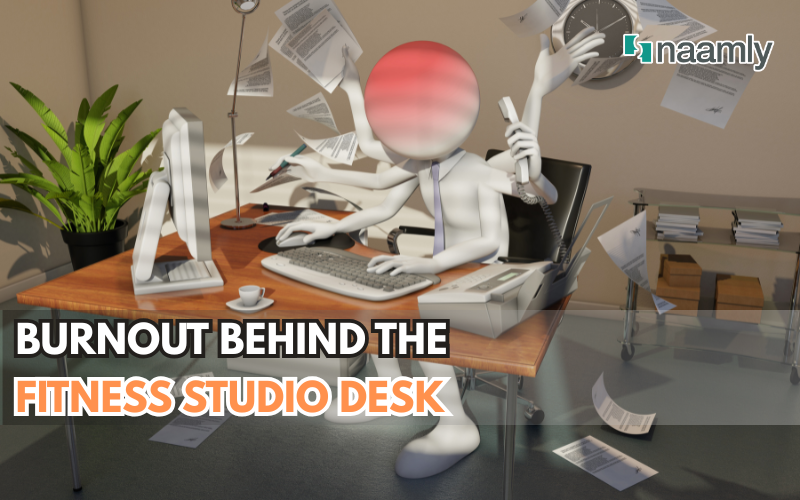
Your studio is growing. Membership is up. You’ve added a couple of employees, maybe expanded the schedule or moved into a bigger space.
So why are you more exhausted than you were when the business was half this size?
Growth has a way of exposing weaknesses in the way a fitness studio operates. Ten members can text the owner directly with questions. A hundred members probably shouldn’t. Three employees can run most decisions past you. Ten employees doing that can consume your day.
Eventually, the habits that helped you build the business can make it harder to run.
That’s one reason gym owner burnout deserves attention as a business problem as well as a personal one. When the owner is overextended, the effects can reach leadership, staff morale, member experience and ultimately the studio’s ability to keep growing.
Why Gym Owner Burnout Happens
Fitness is an unusually demanding business because many owners started out doing the work themselves. You might have been a trainer or coach before you had employees, payroll, marketing, sales, billing, retention and facilities to worry about.
And coaching can still feel like the comfortable part of the job.
Gym business consultant Vince Gabriele has written about owners who sometimes wish they could go back to simply training clients. Coaching is familiar. Running a business requires different skills and brings different pressures, including the uncertainty of finding new clients, hiring and managing employees, and keeping the finances on track.
The problem comes when owners try to do both jobs indefinitely.
“No business benefits from the owner burning themselves out,” Vince says. “The number one asset you have as a gym owner is your brain.”
Remember that when gym owner burnout starts showing up as fatigue, poor concentration, impatience or a growing sense that you simply don’t want to be at the studio anymore.
Pat Rigsby, another longtime fitness-business consultant, makes a similar distinction between being a business owner and essentially creating a self-employed job. If the business still depends on you to handle most of its daily work and decisions, growth can simply create more work for you.
In other words, gym owner burnout isn’t always the result of a struggling business. Success can create it, too.
Passing along responsibilities is its own form of responsibility.
“We don’t set that person up to succeed,” Pat says. “They need to know what success looks like in each situation.”
Know the Warning Signs
Burnout doesn’t necessarily announce itself with a dramatic breakdown. More often, an owner simply starts feeling different about work.
· Maybe you’re unusually irritated by member questions.
· You have less patience when an employee makes a mistake.
· You procrastinate on projects that require sustained attention because you can’t summon the energy.
· You find yourself staring at your laptop after dinner, still thinking about tomorrow’s schedule.
Physical symptoms can show up, too, like persistent fatigue, trouble sleeping and difficulty concentrating.
Vince argues that gym owners need to take their own physical and mental condition seriously because the business depends on their ability to think, make decisions and lead. That’s particularly relevant in fitness, where owners can spend long hours coaching while carrying the additional mental load of running the company.
Watch for another sign: You’ve lost interest in work you used to enjoy. A member question that once felt like an opportunity to help now feels like an interruption. Talking with employees feels like one more demand on your time.
Those changes can affect the studio before you realize how much gym owner burnout has changed the way you lead.
Your Staff Notices
Employees get very good at reading the owner.
If you’re chronically stressed, you might become more impatient or inconsistent.
You rush through conversations or decisions you later reverse.
You put off their personal long-term concerns because you’re too busy putting out fires.
Or you start micromanaging.
That can make the situation worse. Employees who don’t have the authority or confidence to make decisions bring more questions to you. You become busier, which makes you even more reluctant to slow down and teach them how to handle those situations themselves.
Rick Mayo, founder and CEO of Alloy Personal Training, says it’s good to give managers responsibility for day-to-day execution while owners provide vision, oversight and leadership. Owners who constantly step back in to take over can undermine the manager they hired to relieve them.
“You hire the right people (but you don’t step away too far),” Rick says. “Too many people think they can just hire a director and disappear.”
If every decision still requires your blessing, delegation hasn’t accomplished much.
Members probably won’t identify gym owner burnout as the problem. But they’ll experience its effects when you stop behaving at your top levels.
Small lapses matter in a business that’s driven by relationships.
They also accumulate, one thing leading to another and undermining revenue goals.
That’s when burnout starts becoming expensive.

Check on Progress Early
Document Your Processes
One of Pat’s simplest observations about systems is key. You probably already have them. You just haven’t written them down.
You have a preferred way to welcome a prospect, follow up with a lead, handle a cancellation, open the studio, respond to a billing problem or onboard a new member.
But if all that information lives in your head, employees have to keep coming back to you.
Start documenting recurring processes. You don’t need to spend three months writing a 200-page operations manual to minimize gym owner burnout. Pick the questions you answer repeatedly and the problems that repeatedly land on your desk.
Define what a good outcome looks like. Document the steps. Train someone to handle them.
This is one of the most practical ways to reduce gym owner burnout because you’re attacking the repetitive work that consumes time without requiring an owner’s expertise.
Don’t just delegate tasks. Give them accountability for outcomes, too
Delegation also needs to go beyond asking an employee to complete a list of tasks.
A team becomes much more valuable when employees own outcomes instead of simply following instructions.
Of course, that requires training, clear expectations and accountability. You can’t hand someone a responsibility on Tuesday and complain on Thursday that nobody does it as well as you.
Developing people takes time. It also gives you time back. Eventually
Delegating everything isn’t the goal.
Vince says his time goes toward higher-level responsibilities such as marketing, leadership, strategy and making sure the business is moving in the right direction.
That’s a useful exercise for any owner dealing with gym owner burnout: What are the few things in this business that genuinely require you?
Then look at your calendar.
If those responsibilities take only a small fraction of your week, something is out of whack.
Block out specific periods on your calendar for marketing, financial review, employee development, etc. Don’t just give up on those when the latest (metaphorical) fire alarm goes off.
Louder problems aren’t always more important.
Remember to simplify everything from marketing to pricing options. Gym owner burnout becomes real when you’re overwhelmed with non-essential complexity.
Rick says Alloy gained clarity when it decided to focus on one specific underserved segment of the population, not the troublesome “everybody.”
Simplify Where You Can
Complexity creates work.
Look for unnecessary complexity when gym owner burnout starts creeping in. Sometimes the answer isn’t figuring out how to accomplish 47 things more efficiently. It’s deciding whether all 47 still need to be done.
Also: Avoid isolation. It’s easy to lose yourself when you spend so much time alone. Seek out peers, friends, and professional associations.
Reducing gym owner burnout means gradually creating a studio that can handle more without requiring more of you every time it grows. That takes systems employees can follow, managers who have real authority, clear priorities, and an owner willing to let other people become good at work that once belonged exclusively to them.
Pay attention to your own energy, too. Exhaustion affects judgment, patience and leadership long before it forces someone to stop working altogether.
Your studio needs your attention, but not all of it. Really.
Accelerate your success with Naamly’s free Fitness Business Boost Bundle.