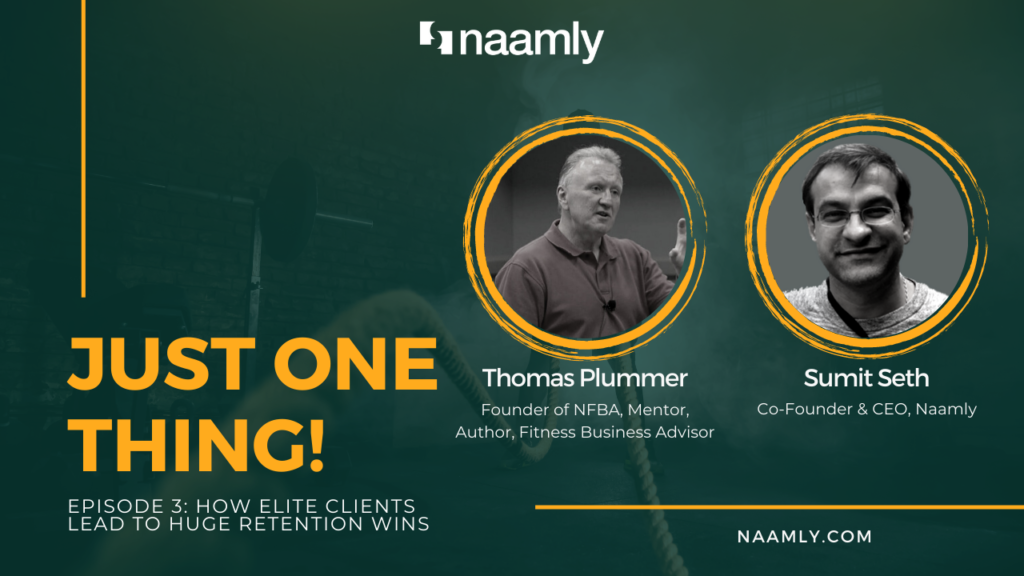
Smart gym owners realize that amazing retention is necessary for strong profitability. So how do you get amazing retention?
You need to have an incredible client experience. This goes beyond the standard bottle of water that the front desk gives out. We are talking about a complete overhaul of how you handle the delivery of your service.
In this episode, we uncover:
- How “respect for the money” is the key to unlocking stellar retention.
- How you can position your clients as elite to strengthen your retention strategy.
- Why you should be investing time and money into your client relationships.
Plus, so much more!
Now that you’re a seasoned pro with the knowledge to provide an incredible client experience… Want help? At Naamly, we empower training gyms like yours every day to set themselves apart with their client experience. We make it simple to hold your clients accountable, streamline your communication, and build an engaging community around your gym. Sign up for a FREE trial to experience the endless benefits of using Naamly for your client outreach.
Watch Episode 3 Now!
Sumit: In our last sessions, you know, one of the things that you talked about is training gyms have a very high. Retention rate and, uh, compared to mainstream gym. So, so speak to me a little bit more about that.
Thomas Plummer: on, um, the big picture with this is I’m always shocked how little people put in to the retention.
That they, the, if I could teach them anything. And I th I think the first rule I would like to lay out here, then we’ll end with this too. We’ll do a little circular. 12 minutes of this time is, uh, you need to learn to respect the money. And most it’s bizarre how few trainers think that way. It’s we, we want clients to pay us and we get the money.
We really don’t show a lot of respect for that money. It’s almost becomes an expectation. It’s really crazy. That’s retention is simple. It’s you gotta remember who’s paying the bills and then take care of that person.
So when we start with retention, it’s, you know, the old joke is, you know, you, if you kept all the members, you signed up the first year and didn’t have to replace them, you’d never have to market ever again. We mark it because we, and you have to start with this mindset is we mark it because we’ve lost clients, we’ve driven them out of our business.
So that the best thing I could teach you about. Getting into retention is if I lose a member, you have to start with, what did I do? Well, the guy died, Tom. I really, really couldn’t do much about that. Well, you know, maybe it could, but you know, if they just it’s that client that just drifts away, that just all of a sudden he go and he doesn’t renew or he doesn’t come back.
Or he used to train eight times a month. Now I see him three or four times a month. And, uh, that type of client is to as heading out the door. We, we, we lose that point. So the biggest thing is you, you to keep a client and it works as part of marketing too, is I’d have to build an emotional connection point between the client and the business.
And then I have to work very, very hard to keep that alive. You know, most trainers get so into the training where I walk in as a client and I stand there for five minutes and you wave me. Yeah. We tell a couple of bad jokes.
Talk about golf, talk about something. I work out and then you’re looking over my shoulder because the next client’s there. And, you know, and after a year or two years you burn me down, there’s a thing called repetition fatigue. And it’s a very important term in the gym business because we, we were the clients out the circuit places like orange theory at 45.
That’s, that’s a natural thing they have to look for in those businesses is if I do that circuit over and over and over again, four or five, six months, then you burned me down. No, you’ve absolutely just. Burn me down to that point because I it’s just, it’s the same thing over and over and over again. But in the gym business, we get so busy being busy that we forget repetition.
That’s why I I’m, I’m trying to teach now things like, uh, team training, you know, that we’re pushing sleds down the floor. We got 30 people screaming, 50 people, you know, if you’re Frank Nash, a hundred people running up and down the floor, but, uh, Been there done that. Two years into it. What do I do? So I’m telling these guys, you should have a boxing program here, a restoration of natural movement program here, a soft flooring over here for meditation, maybe a cardio circuit where I have five treads, five rowers, five assault, bikes, five steelworks.
So I do 12, 12, 12, and 12. So I could run in this case, you know, 20 people through. And so I, I let the client know that, you know, you don’t want to push the sled tonight. You’ve been here a year, you know, go box. You don’t want to box tonight, you know, go to the cycle program. We’re going to cycle program.
You don’t want to cycle tonight. Just go work on the restoration, take, you know, let’s get the stick mobility out. Let’s do that for 40 minutes of the class. So I have to break it up. That’s retention. Uh, the, the connection, the emotional connection is six days a week. I’m sending out gentle emails, texts, not asking for anything.
I’m just like, uh, I’ve got closed community on Facebook. I’ve got things were up constantly keeping, keeping them into things. Quarterly or every two months or even monthly, if you’re a good gym operator, I’ve got a special event at the park where everybody can come and work out for free. And I’m just going to get some beards and wine afterwards, and we’re going to sell lawn chairs after a good workout and just talk, you know, I might have a barbecue, I have to break up the repetition fatigue, but I also have to build the emotional connection.
And I, I, I’m just talking about a hundred things here, so, but probably too many, but one of the things I, uh, I think I’d like to pound in this segment is the word elite, that training gyms one, they’re not studios and they’re not boutiques. There’s nothing upscale elite about. But Pete facility, if I’m talking to the top 40% by demographics in the area, you know, they’re, they’re there because it’s a training gym because there’s a master coach running this place because it’s, it’s the experience.
This is what I need to change my life. So I’m okay with training gym. That’s a cool term, but we also need to use the word elite. So the, the, the team dies. They, you know, the, the CrossFitters, the orange theory, the there’s no elite simply by the sheer numbers of people you run through. But assuming if I come, if I come in, I’m going through Arizona and I stopped by and say, Hey, would you and your wife like to have dinner?
I had my wife. We’re just, you know, we’re going out to the Biltmore for the weekend. And you know, we go out for people. It’s intimate. You know, we sit around, perhaps have a glass of wine and we talk. Yeah, it’s, it’s, there’s something about that. So small group to me is a leader. That’s for people you don’t want to dilute that.
That’s why six and eight and 10 doesn’t work for me because you blow the eliteness. You blow the cool factor. If I’m in the restaurant using that analogy. And then all of a sudden there’s six or eight of us. It’s no more, it’s not a LDT anymore. I don’t get, it’s not four of us leaning in talking, talking about kids, talking about trips.
It’s now a party and I lose the weakness of it. So I four people then one-on-one is always very intimate. So that elite client respect the money. Respect the money. So if I’m charging roughly $80 an hour for training in my world, that would be 4 99 a month for 12 months. You’d come once a week or 8 99 a month for 12 months, you come two to three times a week, some days we’re going to have to talk about why I hate so badly that 1, 2, 3 times a week price structure, but we’ll save that.
But if I’m, if that client in here that, that those clients, if they’re paying me $8 average, okay. I’m going to put back about $50 per month in that client as a reward. Thank you. I respect your money. And the small group people that might be paying 300 a month, I’m going to pay somewhere $30 or so, you know, 25, $30, maybe half what I put my one-on-ones it’s shocking how few training gyms will want to do this.
They will spend $3,000 to bring new clients in. They won’t spend a. Few thousand dollars to keep the clients. They have it. It’s it’s crazy. That’s if I, so you’re my one-on-one client, you’re a CEO of a tech company, your stress, you’ve got employees, you got long days, you know, in your case, you’ve got all kinds of interesting things going on in your life right now.
So you come to the gym, that’s your time, your space. And you’re paying me a lot of money. So, first of all, you’re a one-on-one elite client. You never pay for water. You don’t pay for shakes. You don’t pay for anything. You’re you’re in, you know, nutritional products I sell you, but everything else you pay, it’s just like, get a shake on the way out of the door.
You’re an elite client. Thank you. Every three months you get a bottle of wine every once a year, you get a good, nice gym bag. Once you get some kind of special thing, like a messenger bag or something like that. Found, you know, and so, and you might get a nutrition package a couple of times a year where you get supplements, protein shake, bottle, t-shirt big basket of stuff.
Every month, I’m going to spend $50 on you. And here’s what happens with that client. First month, I give you that the gift basket, you come in and say, Tom, that was so thoughtful, man, but you don’t have to do this. You know, I do some thank you. You, you, you, you’re an elite client here. You, you, you make our business work.
Thank you. Next month you get the why the guy comes in. He goes, Tom, this is ridiculous. Don’t spend this money on me. I just don’t need it, man. Yeah, no, I got money. You know, I don’t need this. I said, thank you. You’re still here. You made my business work third month, the guy goes just, you know, what are you doing?
I say, every month you’re here. You’re going to get the gift for me because I respect your money. You know? Thank you. You can spend it anywhere in town. You pick my gym, you pick me, you’re here every month. You’re going to get something here because you know why it’s just tokens of, you know, thank you.
Thank you so much. Now what’s this guy feel? What is that one? O’clock what’s in his head now. I can’t get the train of guys to think about this. What’s it? This guy’s fat. He’s not leaving. Huh? No. Jim
knows
Sumit: That you can care about me. He’s knows that you think about me all the time. I’m not going anywhere.
You own me. You genuinely own me now,
Thomas Plummer: [00:12:53] but Hey, how about if he, in that gym I was telling you about in Florida where where’s my Christmas present, dude. Uh, you know, that type of thing. So it’s like, I take care of him. I don’t want anything like that. And then once his obligation now to refer. I got to help this kid.
Huge. I’ve never had anybody do that. I, I, we, um, Everybody knows that, that, you know, knows. My name is I I’ve spent the last 40 years out there on the road everywhere. And we, we get to the point where you, you just get so beaten up that you want to shelter and you just, I can’t stand another hotel room, but I’m going to grab a couple.
Uh, by friends, you know, Chris foyer or, you know, whoever’s out there. A couple of whoever’s traveling, you know, old clients, we get, you know, we get small, small group and we go to someplace nice. And it’s our shelter. It’s our retreat. Um, I spend a lot of time with capital grills. I use that analogy often.
They’re a chain all around the country, but they’re, they’re exceptional service. We were sitting there in Providence last year before the virus shut down. And the guy said, have you ever been into one of these before? And I go, sir, this is the 17th different one I’ve been in this year. And I’ve been in this one.
A dozen times or more. And I used to go to the old one down at the pill, the original one before you guys moved it. And I saw, I was telling the whole story and he was laughing. He goes, you’ve been in a seven. He says, you’ve been in more of them than I’ve been in the great, and I said, this is if I have friends, this is where we come with ones available because we love the quality of your product.
And he just, he thanked us and walked away. So we’re sitting there ribeye and wine. Party and he blocks up later. He just sits in that really nice bottle of wine. And he says, thank you. He says, you could have taken your friends anywhere in this town. This is a food town. And you brought him here. Thank you.
And I’m like, how often does that happen now? Loyalty now to this brand going to be even more. You know, most restaurants would thank you. Maybe send you a dessert, big deal that cost them two bucks. Scott chose a a hundred dollars bottle of wine on the table and says, thank you. You know, because, uh, the loyalty I showed to his brain and why do we not see this?
He respected my money. He respected. So the fact that I could have spent my money in Providence, a hundred great restaurants, and one of the best food towns in America. I mean, his restaurant. And he gets so retention. If you think about this, if you’re going in here and I’ll probably way over the limit on this one.
So it, but, uh, uh, I’m looking at this check light timer, dude. I probably blew it. I did. So I’m looking at this and let’s wrap up on this. If I’m, if I could teach you anything about retention, we can always talk about strategy and all that and future ones. But anything about retention is start with. The clients are elite.
They, this is the elite training gym. They are paying us a lot of money to be there. If we respect the money by building that connectional or that emotional connection, they will stay longer and pay longer than they will. In other gyms, I’ve got to learn to respect the money. Yup.
Sumit: That’s that’s brilliant.
And before you know it, you’re only, now you’re not spending any more money in marketing. So it’s all going down to the bottom line and it’s money that you’re now even more profitable.

About the author
Sumit SethFounder, NaamlySumit founded Naamly to give training gyms one system for billing, scheduling, texting and staff accountability, and still runs every product demo himself. He writes about retention, billing and the daily rhythm that lets owners step away from the front desk.
Free download
Want more ways to grow your gym?
Get the Fitness Business Boost Bundle: a checklist, a cheatsheet and a guide from the team behind Naamly.