
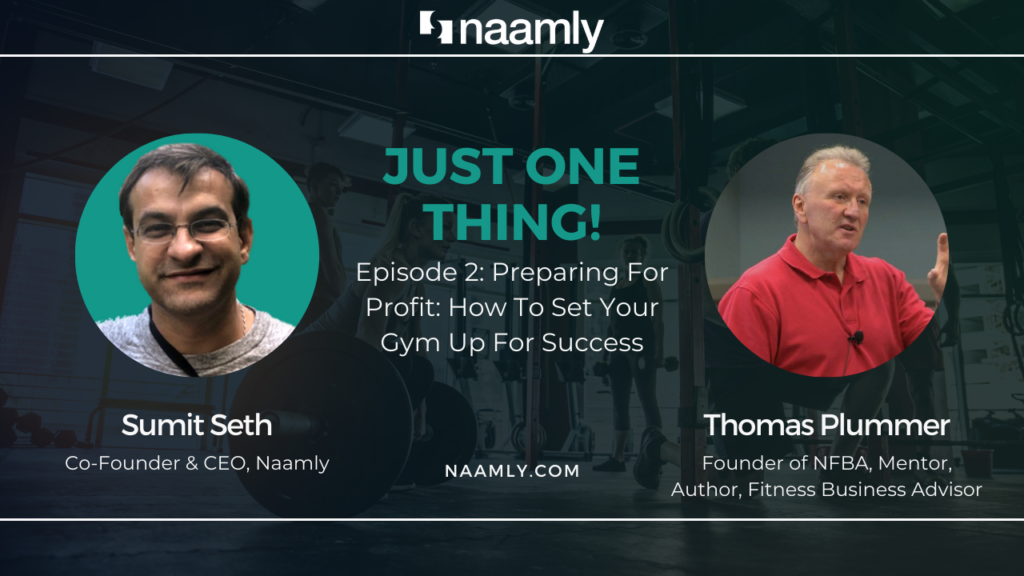
Matching your efforts to your ambitions can be tricky for any gym owner.
Picking up where episode one left off, we walk you through practical steps for preparing your gym for profitability.
In this episode, we teach you…
- How your gym’s location and square footage impact your earning potential.
- The 5 key team members you need to pave the way for profitability.
- The one variable expense in your business that might be costing you.
And tons more!
Haven’t seen episode one yet? Watch it here!
Getting things off your plate is a key step in making sure you can spend your time working on your business. Want help? ➔ Start a FREE trial to see how simple your day-to-day operations can be with Naamly!
Watch It Now!
Sumit: All right, Tom. So, so last episode we talked about. Overcoming your self delimiting beliefs going from, uh, knowing that in within 18 to 24 months, you should be able to hit a million dollars. And this could, the gym business could be a great medium for creating wealth, right? So, and you gave context about it needing to be about 3,500 square feet or above, uh, exceptions are always there to the rule.
Thomas Plummer: You can do it in as low as 1500, 1800. Is there an exception to every rule?
Yeah. If you have a 1500 foot in a small town in Southern Arkansas. You going to have a trouble chasing a million bucks, but in those teams type of markets, it’s, you know, if I make 150,000 a year, I’m probably the wealthiest guy in town. It’s wealth is situational. So there’s always an exception to the rule that we’ll blow this, you know, a time while I am the exception.
Well, you might be, you know, a small town in Southern Arkansas. They, they, their gyms needed, but the top 40% by influence, you know, is 80 grand. It’s not Connecticut, it’s not New York. It’s certainly not Scottsdale, you know, with those areas. So, but it’s still, if I make 150 in Arkansas, that’s like making 500 in Connecticut, you know, it’s enough money to take care of your life.
And it’s enough money to save, you know, because your house is 150 grand versus 1.5 million for the same house in Arkansas versus Connecticut. So it is situational, but still the big issue is most people never see our drive, the potential in their own business. They never find out how good that could business could be because they have limitations.
They bring to the game that prevent them from seeking that because they don’t believe they can.
Sumit: Let’s talk about those three big elements, if you will, because million bucks may sound a lot of money and it very well is, but still, if we’re all giving it away and we are not doing a good job in managing the business, then I’m still not pocketing anything.
Thomas Plummer: Right. Um, If we back up a step on that and start from the perspective. Okay. So, uh, kind of a, a problem is most owners don’t think of the, uh, gym as a. Something set in motion over time. It’s they, they get up in the morning and it’s just, it’s, it’s like, um, it’s a little run in the park and I go home. They, they it’s, it’s a day at a time deal and it’s very intimate.
And as you get more into your business, it becomes more. Um, now it’s always the perspective of put the fire out. Now, solve the problem. Now go to work now, close now and it’s market now. And so you get caught up in that, uh, mediacy of running a business. Then you lose your perspective of what we’re trying to do.
But if you think in terms of something like my gym is in motion and I set it in motion for five years. Um, then you take a different perspective on it. So I’m building a vehicle to go forward over time. So if I look at that, so I, I need, first of all, when I start the business, uh, most guys make the mistake of going.
I need to wait until I make money to hire people instead of funding the gym correctly, where I can start with marketing and start with money, you know, with the staff and start to go. So they wait to grow instead of investing to build the foundation. To do it. So I, I can’t imagine Steve jobs is going well.
Okay. Well, you know, we let’s make some money before we hire somebody. You know, he went out and hired the best people possible cause he brought some investors in and created a vehicle to go forward over time. So if we make that assumption that I start with all the tools, instead of trying to earn my way into staff, then a gym at 3,500 is going to have usually a manager.
She usually going to have a lead trainer. And is usually going to have an assessor, somebody that is sells for the team and takes everybody and first experience for all clients. And I have a marketing person. So then yeah, at that point I had trainers as necessary and then I start to build and then go forward.
So if I’m looking at a training jam with a million dollars revenue, and let’s say it’s 4,500 square. Well then, uh, what, uh, out of that, I should pretax about 400,000. So I tell all owners to pay themselves a salary four to 5,000 a month. And that’s your base. And then you scoop the rest of the money out of the checking account every two to three months as a bonus to owners.
Uh, so that allows us to put key performance indicators in place to see what the business looks like. So if I have a million revenue, 400 pre-tax, I’ve got a salary of the 600 remaining. How did that 600, about 50% of that is payroll. We know that to be true over time, and that’s the biggest mistake they make by managing their money.
Is the payroll gets too crazy. Because they don’t have any perspective of what they’re trying to do, but if they also take out all the money and grab everything themselves, instead of putting themselves on a base number. So if you’re a young owner, I would tell you, so it just, okay, pay yourself four grand a month.
We’re going to take it. You and I are going to agree if I’m coaching you, we gotta to leave $10,000 minimum in the checking account. And over the first two years, we have to save enough money to have a full one month reserve capital. And maybe if we get lucky toward two. Now every three months, we look in there and say, Tom, there’s $20,000 in my checking account.
All my bills are paid. I’m going to go great. Slide that extra 10 out. That’s going to go to you have the discipline to move a thousand of that toward our savings account, and then take the rest as a bonus and tax it up and take it as a bonus to you. But our payroll, our expenses, our marketing person, our lead trainer assessor, everything is built into the 50% revenue or I’m sorry, 50% cost factor of my business.
So if it costs me. $30,000 to pay all my bills and staff 15 of that will be payroll, payroll, taxes, bonuses, and commissions. Okay.
Sumit: So, so let’s do a little bit of deeper dive in. As you were saying that I’ve been putting down these numbers, um, 600,000. We took, we looked at a million, we said 400,000 pre-tax is the profit we’re looking at.
So we’re going to put that aside, we’re left with 600,000, right of that 600,000. We said 50% of that should be attribute it to payroll taxes, bonuses, and all that means $300,000, basically 50% of 600,000. So 300,000 people, uh, across manager, lead trainer, assessor marketing person. And, uh, your coaches as you have it, right?
So five key people as, as I look at it right now.
Thomas Plummer: Yeah. So you’re, you usually play one of those roles yourself. You may manage your own gym. I prefer you manage instead of being the labor in your own gym. But you know, you may be training 10 to 15 hours a week when you start. And we hope to cut back over time.
So you can step back and manage all the moving parts instead of being so involved in training that nothing else gets done in the gym. So I need somebody to act as a manager. Maybe you, your lead trainer, uh, that person takes responsibility for the other trainers, becomes your quality control. It is hard for you to do that and manage your gym, and then tried to be a marketing person marking person’s 20 to 40 hours a week, usually about 20 bucks an hour in today’s market.
Um, and then the assessor is to me, the highest paid person in the gym, because they’re the ones that place my clients at a high dollar dollar average, somewhere in the system. So it’s it’s and then I just fill in with part-time trainers as necessary to go from that point. Okay. So these, yeah, go ahead.
Sumit: So in the 50% payroll, my salary is included.
If I’m the operator manager, uh, of the business is what you’re saying. Yeah.
Thomas Plummer: That’s a good point of what I’m really telling you to do is pay yourself as you would manage yourself. I’m going to pay my manager 50 grand a year or four grand a month. Then pay yourself that salary. If you’re going to do that role.
And we’re still back to the big thing is we don’t generate enough money because we, one, one guy is trying. All those jobs to all the ends up doing is training because all the other jobs become secondary. And then they’re hacked together. Things like customer service just ceased to exist because they just can’t maintain all the moving parts.
And, and again, then the profitability of the business shrinks a final point on this. I know we’re running out of time on this one, but you have to think of your business. It’s like I’ve used this example for many years. It’s like, uh, I used to ski at copper mountain for years in Colorado. Well, at that point, if they had 5,000 skiers on the mountain, that was a break even day.
You know, they, if they had 12,000 skiers, their expenses didn’t go up. They were a fixed expense business. Meaning once I get to a certain point, I can add more clients and it’s all profit. So my cost labor really doesn’t go up that much in a skier. You’re. Ski school. Labor might go up. If you teach more lessons and they might eat more the food, but my cost of running lifts is the same.
My fee patrolled expenses are the same. I groomers and guide running up and down the slopes, keeping things going. That’s all the same because once it’s in motion, most guys get to that point, slightly profitable stance. And then that’s it. No, I’m making 80 grand a year. Woohoo. And they quit, but I could add another a hundred clients to that gym.
And it’s expensive to go up this much because we are a fixed expense business. So most guys quit just before it gets really good. And so that’s why a small gym can do a million dollars, like 4,500 foot, because there’s a point where I just, I could add more and more clients and get to the point where in that type of gym, uh, 4,000 feet, 4,200, that Jim will work really well with 350 clients, even 2 75, if I’m averaging north of 300.
And that’s what I have to look at. So fix the fixed expenses. The one that the world will look at here got
Sumit: it. So 275 to three 50 clients is the one piece of pillar for a million dollar business. And the other part of it is 40% profitability. 600,000, they expense part 50% of that going to payroll. And then the other is set across basic expenses, rent building, you know, whatever.
Thomas Plummer: What have you. Yeah, the ranch, traditionally, depending on the aggressive of the rent, it ranges between 25% of your total expenses to one third of your expenses. When your rent costs $24 crosses $24 a foot. I get up into those higher metropolitan ranch, 36 bucks, a foot 48 bucks a foot that traditionally becomes a third.
If my rent’s lower than that sometimes becomes a fourth. Of of my expenses because it’s, I’ve got more slop factor that it becomes a lesser number. So it’s kind of regulated down and I have marketing expenses of ideally of $3,000 a month. Right now that’s going out. But the rest of it is fix your phone is what it is your.
Every, you know, everything else becomes set. The only real variable in the business is going to be your payroll. That’s where the mistakes are made.
But overall, that, that gets you into the $25,000 a month club, which again is a good number. I don’t mean to make that number down, but $20,005,000 a month is the starting number. That’s my foundation. I’ve arrived. I’m in the game. I paid my dues, you know, it’s like first games starting for Tampa bay with Brady.
I’m standing down on the field. I got into the game. What I do after that is determined by the, how I run my business from that point forward. Perfect. So
Sumit: I think what we should talk about next is. About funding the business. How do I, if I’m a trainer I’m aspiring to open my own training gym. Yes. I have visions and aspirations to get to a million dollars, but how do I start?
I do want to get it out. It’s better to get into the game also. Right? You want to play? So how do I do that? What should I do about funding? And you said 25 K like how soon should we get there? So why don’t we talk about that next? And we’ll go from there.
Thomas Plummer: Perfect. All right. Yeah.

About the author
Sumit SethFounder, NaamlySumit founded Naamly to give training gyms one system for billing, scheduling, texting and staff accountability, and still runs every product demo himself. He writes about retention, billing and the daily rhythm that lets owners step away from the front desk.
Free download
Want more ways to grow your gym?
Get the Fitness Business Boost Bundle: a checklist, a cheatsheet and a guide from the team behind Naamly.