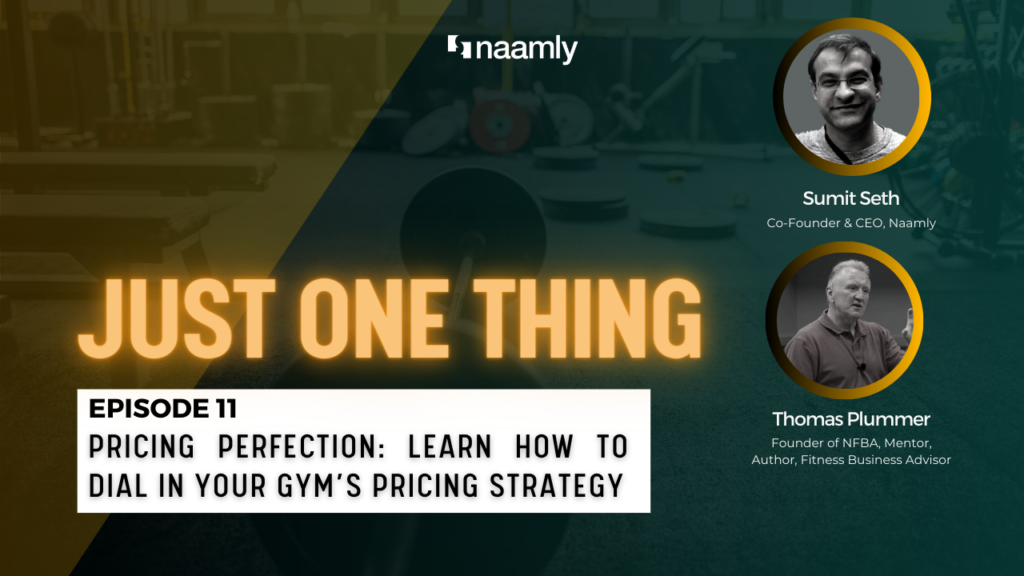
As a gym owner, finding the right pricing strategy can be a tedious and exhausting experience…
Can you relate to either of the following scenarios?
“I don’t want to price myself out of the market”
OR
“I don’t know what variables I should consider when building my pricing strategy”
This week on Just One Thing, we aim to give you a shortcut.
In this episode, we chat about:
- Common and costly mistakes gym owners make with pricing.
- Exactly how to price your services for optimal sales and long-term profitability.
- How many pricing options your gym should have.
If you’re in need of a simple and effective pricing strategy, look no further.
Now that you’re a pro at perfect pricing, you can focus on making a bigger impact! Best of all, Naamly can help. Use Naamly to mass send personalized messages, follow up with leads, and build lasting relationships with your clients. Schedule your FREE trial now!
Watch The Full Episode
Sumit: Good morning, Tom,
Thomas Plummer: We’re back again, really looking forward to these I’m
excited. I actually look forward to this day when I get to sit down with you and just, you know, pick your brains. Like this is the best thing ever for me as well. So, and I know my listeners are enjoying
Thomas Plummer: it tremendous. Uh, it’s fun. I get to talk about stuff I never get to talk about.
So this is always a good one. So, so what’s your subject today? Lay it on me. What are we talking? Yeah. So
Sumit: Yeah. So in today’s just one thing episode. What I want to talk about is the pricing options. You know, in our last couple of episodes, you spoke about nutrition, accountability, memberships, elite clients. And I was like, let me step back.
And see as a gym owner, what should be my service offerings? What should I be, even offering to my clients and what should I be charging for them? And, uh, what are the mistakes that you see people do it? Like, I think three-part question all centered around pricing options per se. So,
Thomas Plummer: yeah. Okay. Uh, Well, let’s start with the biggest mistake.
I think the mistake people make when, when they’re starting to set prices, is they, they copy everybody else’s nonsense and, and do they don’t look at where they live because the pricing has to be a representation of the value of the market that you operate in. That’s a mistake. A lot of chains make is like, okay, I’ve got all these gyms that this gym is in, you know, downtown Detroit.
And this gym is in Pasadena and we’re charging the same thing. And it’s just, the price has have to reflect the market where you live. They have to reflect the economy they have. So you could have five different gyms and really have different price structures in those gems because they really in many ways, need to reflect the market of your end.
So we started with that is that your, your prices have to be situational for the influence in your market. We also think about this if we’re training jam, which almost all the listeners. You know, I, I think of your show art is that then you’re gearing this toward the top 40% by the affluence in your market.
So another mistake is that people, they they’re afraid that they’re going to price too heavy because somebody says, oh my God, that’s so expensive. How can you charge that? That’s the guy sitting at the bottom 60% that says. And it’s, uh, it’s incredible. I,
So another basic mistake we make is we need, we, we, we broad base our prices instead of trying to go target specific for the market. We want in the gym, assuming that there are going to be people coming into the gym and go, oh my God, it’s too expensive.
You’re not a client. If money is your deciding factor, you’re not going to be happy in this. You know, this is, you know, we sell range rovers. We sell Jaguars, we sell Mercedes top of the line cars. We don’t sell Kias. So sir, if you want to keep, you need to go to Akila place and it’s called my competition and they’re cheap and they’re down the street and go, go do it.
So another thing we make is we, we make them too complex and we tend in this industry, fitness industry tend to break all the rules. Known research on pricing and it is in depth of how much we know about pricing. Um, it goes back to the level of real research started in the 1950s. When the, we started the first time, they really started to look at how the consumer could buy.
We came into first generation of computers, so we could be able to track buying habits that, that the databases on consumers behavior is one of probably the most recorded things. On the planet and yet gyms, defied that they think, oh, well, we’re the exception to the rule. And, um, basic thing is there’s always too many choices.
We try to throw too many things down, trying to hit every possible scenario that a client could ask us about.
So when we started to do small group training and even one-on-one and read and modify it, we went 1, 2, 3 times a week. And I will tell everybody that I was horribly wrong with that because I broke the rules, um, because it’s too many choices. And statistically we know from research from looking at how people buy that they, when you have three choices.
So let’s say small group training at 1 79 to 79 and 3 79. So one time a week, two times a week and three times. Statistically 50, 55% of the people pick the middle 45% pick the lower. Only about 5% will pick it because well, they go the middle, like two weeks. That’s all I really need.
And then if you look at a typical sales situation, like a car dealership, well, you know, almost everybody’s bought a car. If you buy from an experienced salesperson that knows what they’re doing, do they not always get it down to two? Which one of these is best for you at the red one? Are you going to buy the black one?
They never throw three because it shuts the guy down. They, and we look at this.
So it’s a mistake because it drops your price. I’m a fan of the structural thing where it’s keep it simple.
Would you like to come once a week or would you like to come two to three times a week? So that 1 79 to Sydney trees, they’re not going to go away. It would be maybe 3, 4, 2 49 and three 40. So 2 49, I can come once a week. And if I want to come two or three times a week, depending on the time of year, my kids are in school, out of school, whatever it’s, you know, here, but now we have a 40, 60 split, not a 5 50, 45 split.
So statistically, it works more because now your average price goes up because, and you just say two to three times a week, but trainers are so anal. It’s like, well, if the guy comes three times a week, So what, you know, it’s, he’s paying more for the privilege of coming that way, but statistically, your average is much higher in this system than it is with the three layers.
Yep. But no matter how many times I teach that somebody will go to a little mentorship and there’ll be 20 guys in there. And they all, well, I do want to three because I had this client that said, man, they all do the same thing. So going back to my rant on, this is one of the biggest mistakes we make with pricing as we ignore it.
All the technology that supports how the consumer really does buy
if I had to summarize the mistakes, we make a price.
Too complicated. We have too many layers.
Another mistake we make is we try to price to broad base. We, we, we, we don’t understand that we want to be priced. So a there’s a certain client that can’t afford the gym.
There’s no perfect price. The you there’s no price where somebody won’t bitch and that step, uh, planet fitness is a perfect example of that. They, they do $10 memberships, a company called wow. Opened $9 memberships. And then there was a guy in Oregon that was doing a full five memberships for $20. So he was doing so you just one guy paid 20, but you could bring four friends.
So. $4 membership. So. Everybody’s looking for the perfect price where people don’t bitch and complain. Can you imagine somebody walking in going, look, the guy down the Street’s $4, you charge nine. I mean, it’s, it’s like you, you, you can’t make, so you have to price for your target market. So if I’m building a training gym and my client’s going to be one-on-one.
And small group and high-end even team. Then I price for the top 40% of the demographics. And I have to understand there’s clients can be walking in. They can’t afford it. And I can’t panic and go, oh my God, my prices are too high. No, the guy’s too young. He’s first job he’s broke or, you know, he’s struggling.
And to do this, you have to price for your model. And so we, we tend to do this, but also the wealthier client seems more valuable in the higher price because they don’t like cheap prices because it’s too good to be true. And that’s, so again, I’ve used, I’ve, I’ve done that a thousand times in the workshop.
I point to two guys, a hundred dollars an hour trainer, $200, our trainer, which ones. And, but they, everybody wants to charge the a hundred because all my dogs, you know, I don’t have any money. Nobody else does. And the $200 guy, bill, no accountant walking in, you know, with a 50 man firm goes a $200. He’s gotta be the best guy.
He’s got them enough confidence to charge the highest hour, but he’s got to be the best. So we know alternative market. Uh, and then as we think about this, we have to start thinking about what we’re trying to do. We’re looking for stability. Now we’re looking at the month of month, doesn’t work. The things like that, where I’ve seen guys do that, where, oh my God, my market’s different.
I can’t do month to month. Your sales systems. Right? The client’s not different. So biggest mistake there is you all your clients should be on 12 month contractual obligations because that builds a receivable basis stability. So a lot of the young coaches want to go month to month, or even God forbid packages and sessions.
So we make so many mistakes in pricing that it really almost. We have to work so hard to overcome our own pricing structure and the pricing structure is supposed to enhance our business and build wealth for us. And most of the time it works against us and actually kind of backfires because we make so many mistakes with it.
Yep.
Sumit: So, so let me, let me summarize all the different, amazing nuggets that you threw out there, Tom. And that was taking notes. Pricing is situational. You got to price it for the market. That is the. Think about the top 40% influence wise, don’t keep, don’t make it complex, you know, 99, 1 rule, like you said, keep it simple and don’t give them so many options.
Now, I think we’re seeing that you also threw out some other elements here, which said you have high-end treat team, you have small group training and you have, um, one-on-one so there’s really three. Now a couple with something that you mentioned in the previous episode. Where does nutrition now come in?
Where does accountability add on the bolts on come in and, and what does happen as you were giving some insights about accessibility to one time a week, two times a week? Like, so isn’t my pricing structure, even in this simple model becoming complicated now
Thomas Plummer: or so, so Nope,
So if you think about it, there’s three clients. So you have to market, you have to price for the three clients within a gym, and most guys don’t think this through when they opened their gym, they just, I I’m going to market and people are going to come in. Well, what people are going to come in? Well, people with money.
Well that doesn’t tell me. So I, I, I have to look at my market as three different segments in the trading world that 24 to 35, 36 year old client is our team client. That guy would be a head teller at the bank. She might be a, a school teacher. She might be somebody in there that she can afford this baby, but they’re young.
And they normally gravitate toward team training because of the price and because of their age now, small group training that is a 35 to 55 year old market. Now that overlap of the thirties, that 35 year old person in small group may be a senior agent at state farm and making a lot of money versus the guy in team is 35 years old and he’s a waiter, you know?
So there’s, that’s why. But that 35 to 55 segment, that is an older person. They still like the group dynamic, but they maybe not one-on-one they still like the small group. So we sell them small. And we sell them, uh, that, that becomes once we get past team, we get into the elite training and I I’ve, I’ve had so many discussions on this lately is that trend in team is just to shove more people or small group, more people in it.
Well, it’s six or eight.
When you add six people, two more people, you’ve got six. It’s not intimate anymore. It’s kind of a party. So the four people, that’s what people want a small group. They want the intimacy. And when you break that rule, it’s just team training. You’re the same thing.
There’s, you know, I expected if I pay more to have it to be a better experience. Well, if I’m paying you $500 a month or $400 a month, or a one-on-one client, a thousand dollars a month.
Aye. Aye. Aye. I know you’re a good trainer. I already believe is that. So it’s not about the training. It’s how you deliver it. It’s the experience of the training. It’s the overall guidance of the training. It’s the support I’m going to get with this there, it has to go beyond that. So that client is 40, 65, but the number one reason they’re there is not because you’re the best trainer in the world.
They’re there because it’s private. They’re there because they hate people. They’re there because he’s got 60 employees and hates all of them. He’s there because for one hour, it’s all about him. So, I just want you to lead. They’re not there because you’re the best coach ever they’re there because you’ve created a sense of eliteness and privacy.
So we sell eliteness and we forget that we just would not selling workouts. Do you want to reach out through the camera and grab every trainer? It’s not that damn workout you’re selling in this case. Eliteness you’re selling privacy. You’re selling exclusivity. That’s why I love the pod systems in the gym where you have your little mini gyms, all the within your gym, little 300 foot self-contained gems.
Where I take my client. I don’t have to share equipment drag equipment. I don’t have to go anywhere else in the gym. He’s got his own gym. It’s 300 feet and he’s got me, the coach, and that’s all he want. And if people look over and go, uh, look the big, you know, wealthy guy one-on-one there’s one-on-one trainer.
He kind of gets a little status out of that, but it’s an elite it’s we’re selling that privacy eliteness. We’re selling the ability to protect this client. It’s it’s never about the damn workout. He makes the assumption that you’re a good trainer, that he’s going to get results. That’s a basic assumption of paying 400 a month.
I’m going to get in shape. That’s what I’m paying you 400 a month. It’s what you wrap around it. Back to your question about nutrition, that nutrition is any of these layers. It’s just an add-on 12 week program that I’d made drop in and do just to reset my body as I start my training. So if I come in, I’m a stressed out business guy, 40 pounds over, I might want to do one-on-one and a 12 week nutrition program, accountability program.
To get myself started, get myself reset. But th the nutrition may the go away, or I might pay you 90 bucks a month for just accountability program and my supplements or something. But I, the program, that’s what we called a wraparound is I use, I grab it out of the closet, use it once I need it, but I put it back in the closet if I don’t need it as the client.
So the price structure, we, the mistake we make is we, we don’t understand that we’re creating prices. Not just for different people with money, but for different clients, with different expectations and different needs and the better coaches understand that, that one-on-one client, it’s not just different because he’s got more money, but his, what he wants is just radically different than what the team guy wants.
Yeah. So let me ask you this. It’s crazy. I get it. Uh,
Sumit: and these are great. Like the way you broke up the persona. To say, Hey team client, the younger population, small group training, 35 to 55 overlap. And then the elite helped me understand this from a pricing perspective, it’s a bolt on nutrition is 99 bucks or a ongoing, or like we were talking about in a previous episode, 400 for a 12 week accountability segment of it.
What would be the pricing for these
Thomas Plummer: three? Uh,
Sumit: and I understand pricing is situational. So give me a range. Uh, to thinking about the coast and then the middle, what would it look like? Because you talked to so many gyms,
Thomas Plummer: the, the easiest way to look at it is first of all, start with your one-on-one. What do I want to get for one-on-one the trend.
And I’m trying to hammer this trend hard with all my clients is, um, in many of our gyms, we just did away with the team price. So because, um, I’ve got a guy who’s got a 10,000 foot gym in Pennsylvania. Um, we just did away with his team price, which was 1 79, I think, excuse me. And his lower entry price is now two 20.
So you’ve got a 10,000 foot gym, which is the entry price into this gym is 2 29. That that is team, but you get five. Yeah, five small groups with that. Cause he just, he ended up just hating the team people because they were so cheap. He had some old team people down at 1 49, but they’re the biggest pain in the ass is they bitch and moan about everything because they’re paying less.
So he just said, okay, I’m still going to do team, but it’s going to include small group and that pre-qualifies them because now they’re paying a higher rate and now we use this team to support. Training team is not a standalone like orange theory team is boxing restoration of natural movement, guided meditation, normal team training, pushing sleds, flipping kettlebells.
So if I take one-on-one training, I have the option, whether I use it or not to jump into small group of my off days to kind of fill out my skin.
Enough, um, uh, yeah, I can even go down in box if I want. So by having these extra activities, it breaks repetition fatigue, but it builds value in the membership because I get my level, but I get this, this and this below my level. So it, it allows us to kind of take a client. And immerse them into all the layers that we have, and it keeps, it kills repetition fatigue, but it justifies and value in the price back to the price structure itself.
If I know my one-on-one rate, then I can set the rice, the rest of the price. Okay. So if everybody else in town is charging, this would be, uh, Pennsylvania. This could be Ohio, like Columbus markets like that. Omaha places, Chicago, maybe. So let’s say the price is average price in it in the city is 91. What am I going to be a hundred to 125.
So we’ll look at a hundred, then I’m looking once I get my five, right. Five times a month. So based on that, so that that’s 4 99, that’s 4 99 a month for 12 months. And that gets me five times. Once I know that price, then I ju I can go from there. So if it’s 4 99 for that, I just, again, take the four. I’ve got 8 99 for two to three times a week.
Okay. Then underneath that, I just, I can easily drop a hundred dollars down to, uh, Two to three times a week, team training at 3 79 and 2 79 for a once a week team. And if I once a week, small group 3 79 for a small group, two to three times, and then I’ve got 2 79, I can go down to 1 99 or 1 79 for my team rate.
And so now I’ve got 1 79 team 2 79, 3 79, 4 99, 8 99. And that would be a simple price structure I could use as somebody who doesn’t want to do a contract. All these are doable for 20% more. So once I know my one-on-one rate, I could do it. So if I’m an architect, And I’m charging $60 and everybody in town, it starts in 50.
Then I just have to adjust all the prices up and down because that $60 now, five times five that’s 2 99. Then my team, my small group rate might be as low as 2 19 1 19 small group. And then my team rate might only be $89 in that market, but okay. So $60 in Arkansas. In most markets for one-on-one is the same as $300 in Manhattan.
It’s the same spend. We it’s the same equivalent. That’s what trainers don’t understand. That’s why prices need to be situational because Hey, you charged 60. I’m only charging 60 dude in your market. 60 is outrageous because everybody’s charging 50. You’re the highest price trainer. And you want to be the highest price trainer in the market because the money guide gets.
You know, and I think we talked about this in one of our past segments, but if this guy a hundred and this guy’s 200, which one’s the best. The money guy is always going to point to the 200. Yeah. The guys that can’t afford them, I might not take you the one, but he’s not our client, you know, so I want to be by intent, the highest price and weirdly a side note, I even tell my I’ve got a lot of guys on coaching on how to be consultants and how to, you know, kind of be.
You know, they want to be gurus or front of the room. People write books, be consultants. I’ve got a whole stable of those guys now, which is kind of fun. Cause that’s a lot of fun to talk about, but it’s the same thing in the market segments that they’re pursuing, which is real estate and financial services.
Other things like that. It’s like, I want you to be the highest price person there is because the money person sees the value in that you can’t, you can’t be the best and the cheapest, that’s an old adage, but it’s a lot of truth.
Sumit: That is true. You can only get two out of the three as it goes, right? Speed, quality and price.
But fair enough. So Tom, coming back to this, now I want to connect the dots with the mistakes that you mentioned too many options. Now, as I, as you were giving this, and I was writing it down team, small group elite, and then within team, you had 1 79 2. So am I not guilty of
Thomas Plummer: giving too many options now? Or.
Sumit: Am I approaching this wrong? I mean, w where am I falling off now?
Thomas Plummer: Well, if you think about it, I only have two options for each target category. So yeah, my, if my 35 to 50 year old person, one small group, they only have two choices. So yeah, I may show that, but if you contrast that with a. Uh, what’s example, I hilarious price guy, um, 27 years in business.
And, uh, I went to see him just before the virus and, um, uh, we’re looking at everything and I’m looking at his price structure and it was pages, not, not, not a page. It was pages. And if you think about that, it’d be buddy Jim business over period of time. They always add, but they never take anything away because somebody will come in and say, no, you know, I’m just going to sign up, but you know, it’s out another one.
Yeah. They add another one. Cause you know, that’s, I don’t see this under your price structure, but that’s kind of what I want. If I’m going to sign up and the guy goes, oh my God, I got to have that. There’s a whole, and then after five years you’ve got no longer. A couple of one page choices. Now you’ve got pages and, and then you have prices for seniors and you have prices for cops and you have prices for this group and that group.
And all of a sudden, I have to look through several pages. So how do you present the price? So I want the prices presented on one page. And if you think about. You know, we’ve only have five, maybe six price structure. So I beat the team that won 79, a small group, maybe 2 49 and 3 49 one-on-one could be 4 99, 8 94, 9 9, 8 99.
And then if you have a high end nutrition program and you have a really. Like C O type crowd. You might have a 1299 where every program is individualized. His full nutrition every month is included. He gets two massages a month. Cause I, I pay him massage person in my industrial park to do that. And, um, I that’s a total pampering membership, you know?
But in that case, even that I only have six prices on the sheet. And by when I look at the person in front of me and you know, she’s 28 years old and loves team, I will show her the rest of the prices, but that makes her team rate look really good because I got guys in here paying 1299 a month and she’s paying 1 79.
Uh, so she really has one option. Well, that’s true. That’s true. So you would keep it simple pages.
Sumit: I know I have a few clients. That this is, this is bizarre where, and their pricing changes depending on how many people show up in the small group. So it is so it’s technically no more than four, but if only two people show up, then the price goes up.
Per session because only two people showed up. It’s it’s so
Thomas Plummer: bizarre. That would last once for me, you know, what’d you sell me, you know, what’s your number. Well, this is your membership and this is what I paid for. It’s like joining an orange theory and then you want to come at five o’clock and they put you on a waiting list.
Well, I’m paying you $179 a month and I’m on a waiting list in the gym that I signed up to work out. No, you didn’t sign up soon enough for this class. Well, that’s going to last once and I’m out of there, you know, same thing. It’s just, why, why would you punish the client? That’s your fault? So you, you set that in motion, you, but you know how common that is?
I mean, that would be. How many times we talked about this and the other episodes is that we, we, the trainers don’t unders they don’t respect the money of the people that pay him. You’re not respecting your client doing that. You know, you’re like, oh my God. So you, what? You got a better experience on charging more?
You, I booked a time slot. This is a small group training. I up to four people, two showed up today. Big deal. Let’s train. Well, I got to charge you more because you know, the other guy didn’t show up. So you’re charging me. That guy didn’t show up. How long do you think that’s going to last? You just blew your own business.
Yeah. And it’s an administrative
Sumit: overhead for me because I need to keep going in and changing. You’re not simplifying things, which was the other mistake you spoke about? Um, it’s funny, there was this other angle that you were talking about. The options thing, how team training looks so much more attractive than compared to the bigger price.
And I, I was reading a sales book somewhere. Oh, God, it just popped in my head. Where did they said, if you go to the movies, the same thing about the options they’re outrageously priced the popcorn. But there is a medium and a large two options. Exactly what you were saying. The medium is four 50 and that’s outrageous, but it looks good.
The moment you say the large is 5 25 or something like 5 25 for popcorn. Oh, it’s four 50 medium. I’ll take the medium and now they ended up taking the medium, that kind of thing, but it’s, it’s outrageous to begin.
in training gym business, where the guys that are.
[Top 40% by influence that client is recession proof. That client is Bulletproof, that client equates price the service. So once you charge real money, then everything else has to match.
So I’m going to end it over here. We got a lot of great nuggets here. I’m going to go back to this, uh, repeatedly, because pricing, like you said, is, is all over the board.
It’s all over the place. And I see that with our clients as well. So, so thank you once again, Tom. I appreciate it. I love this time and uh,Thomas Plummer: till next time, talk to you soon. Yep.

About the author
Sumit SethFounder, NaamlySumit founded Naamly to give training gyms one system for billing, scheduling, texting and staff accountability, and still runs every product demo himself. He writes about retention, billing and the daily rhythm that lets owners step away from the front desk.
Free download
Want more ways to grow your gym?
Get the Fitness Business Boost Bundle: a checklist, a cheatsheet and a guide from the team behind Naamly.