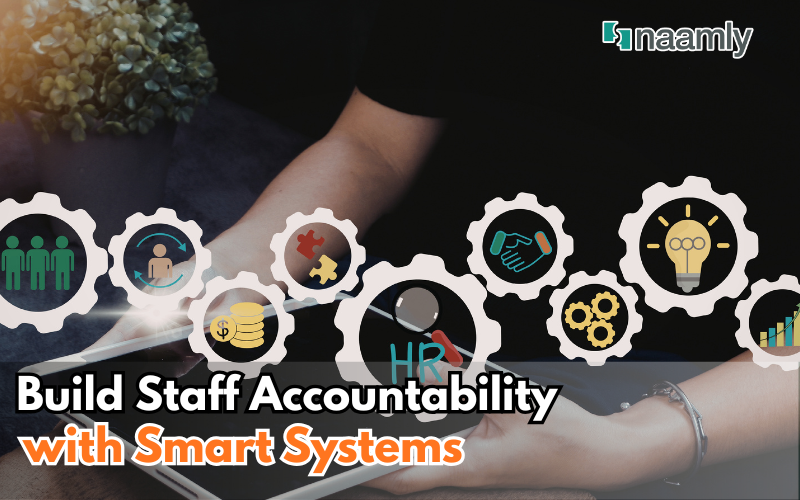
Build Staff Accountability with Smart Systems
 Sumit SethFounder, Naamly
6 min read
Sumit SethFounder, Naamly
6 min read
Your gym runs on your staff, not just on the equipment or the programming or the marketing. It’s on the people who show up, follow through, and take ownership of the work.
But that sense of ownership doesn’t happen automatically. And without the right systems in place, even your best employees operate in the dark. They can be left unclear on priorities, unsure what was completed, and with no real way to track progress.
That’s not a people problem. It’s a systems problem.
Gym staff accountability starts with structure. And structure starts with smart systems.
What Accountability Looks Like in a Gym
The last word in “gym staff accountability” gets misunderstood. A lot of gym owners treat it like a personality trait, something each team member either has or doesn’t.
But that’s backwards.
For example, a staff member who “drops the ball” on follow-ups isn’t necessarily unreliable. Often, they simply weren’t given a clear way to know what was expected, when, and how to confirm it was done.
When there’s no system to catch the miss, the owner notices it long after the fact. By then, the damage is done. Say, a lead went cold, a member didn’t get a check-in, a cleaning task was skipped.
Gym staff accountability requires visibility. Someone has to be able to see what was assigned, what was completed, and what slipped through. In a busy gym, that visibility comes from tools, not trying to remember.
Automation Removes the Grey Areas
A common breakdown in gym staff accountability comes from a lack of clarity.
· Who was supposed to call that inactive member?
· When was the last time someone ran through the onboarding checklist with a new client?
· Did the front desk confirm tomorrow’s appointments?
When tasks live in someone’s head, or in a quick handoff between shifts, they’re invisible. So, they don’t get tracked. And they don’t get done consistently.
Automation solves this at the root. When your system automatically assigns tasks, sends reminders, and escalates anything that’s overdue, the guesswork disappears.
The task either got done or it didn’t. That’s it.
This matters beyond just operations. Automating gym tasks reduces admin workload by as much as 65%, giving staff more time to focus on what actually matters: the members. That’s time that was previously spent chasing down information, confirming handoffs, or filling out manual logs.
When your employees aren’t buried in admin, they’re more present on the floor. And more presence leads to better member experiences, which is the whole point.

Gym Staff Accountability and Creating Evidence
There’s a meaningful difference between telling a team member what to do and having a system that shows whether it happened.
Task tracking tools give gym owners that second piece. Task management software supports routine operations as well as special projects, with tools for clear descriptions, due dates, and priority levels — plus tracking of status, with indicators of progress and verification when something’s done.
Good employees see this as fair. Everyone knows what’s expected with gym staff accountability. Everyone can see the same information. No one is working from a different version of the truth.
For gym owners, it also changes the nature of performance conversations.
Instead of relying on impressions or memory when reviewing a team member’s work, you have a record. You can see patterns — who’s consistently completing tasks on time, who tends to need follow-up, where the operational gaps are.
Gym staff accountability becomes something you can manage with data, not just intuition.
The right platforms make staff coordination seamless, allowing team members to log notes, perform internal communication, and manage tasks without pulling the owner into every decision.
That’s how a well-run business operates.
One of the quiet advantages of smart gym management systems is what they reveal over time.
When you can see how your staff performs across weeks, you notice things that are easy to miss in the daily rush.
· Which team members are consistently engaging members?
· Who’s flagging equipment issues promptly?
· Where are the gaps between what’s supposed to happen and what actually does?
You can’t manage what you don’t measure — and most gyms don’t measure their staff performance systematically.
Useful metrics for front desk staff include things like new member onboarding completion rates and complaint resolution time. Floor staff metrics might track member interactions per shift or how promptly issues get flagged and resolved.
But gym staff accountability doesn’t mean you’re creating a surveillance culture. Numbers are meant to give managers a foundation for coaching. When a team member knows their numbers, they can improve them. When an owner can see the data, they can have a specific, useful conversation instead of a vague one.
The goal of smart gym management software is to give owners control, visibility, and automation for the sake of a good member experience — including the ability to track attendance, review performance progress for employees, and leverage automation for increased engagement.
Control, visibility and automation build a culture of gym staff accountability. Not pressure or micromanagement. A system that makes excellence visible and makes it easier to do the right thing than to skip it.

Building a Culture That Runs Without You
The best version of gym staff accountability is the one where the owner doesn’t have to enforce it personally every day. That’s the culture you’re building toward, a team that takes ownership because the systems make it natural.
That starts with:
· Clear assignments. Every task has an owner, a due date, and a definition of done. No handoffs that live in the air.
· Automatic reminders. The system follows up, not the owner. Staff get notified before things are due and again if something is overdue.
· Shared visibility. The whole team can see the status of shared tasks. No one can claim they didn’t know something was pending.
· Regular performance reviews grounded in data. Not gut feelings. Not impressions. Actual numbers from the system that support honest, productive conversations.
When all of this is in place, gym staff accountability stops being something you have to demand and starts being something the culture produces on its own. Your staff operates with confidence. Your operations stay consistent. And your members feel the difference.
The Right Tools Make It Possible
None of this works without the right platform underneath it. A communication and task management tool built specifically for gyms gives you the infrastructure to make all of this happen — automated follow-ups, task tracking, staff performance visibility, etc.
Naamly is built with exactly these needs in mind. When gym staff accountability is supported by a smart system, gym owners can step back from the daily scramble and start leading the business instead of just running it.
The goal isn’t a perfectly managed to-do list. The goal is a gym that operates with consistency, delivers a great member experience, and builds a team that’s proud of the work they do.
That’s what the right systems make possible.
More free staffing tips: 12 Places to Hire Your Next Star Trainer.

About the author
Sumit SethFounder, NaamlySumit founded Naamly to give training gyms one system for billing, scheduling, texting and staff accountability, and still runs every product demo himself. He writes about retention, billing and the daily rhythm that lets owners step away from the front desk.
Free download
Want more ways to grow your gym?
Get the Fitness Business Boost Bundle: a checklist, a cheatsheet and a guide from the team behind Naamly.